






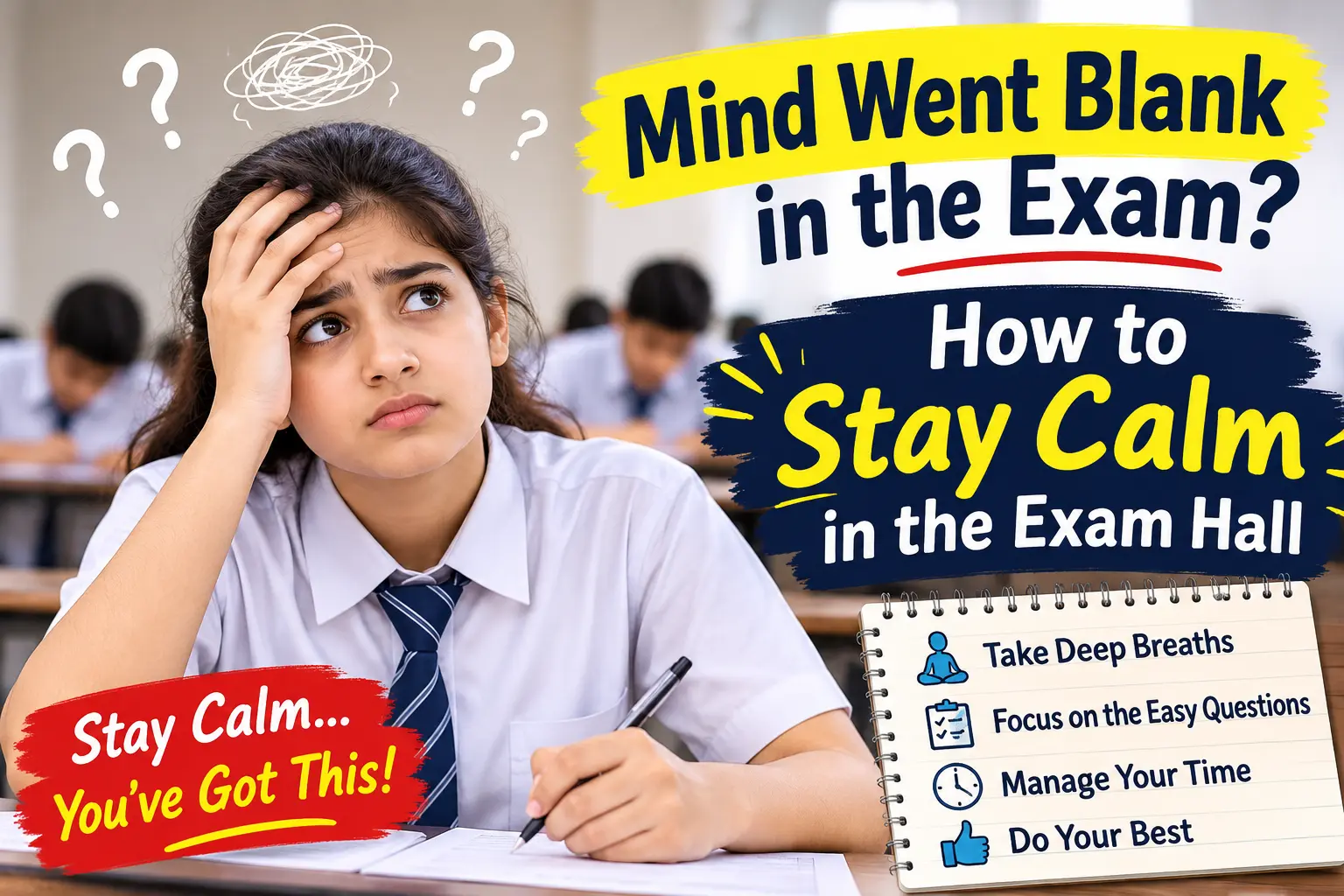
If your mind goes blank in the exam hall, you haven’t forgotten everything. Stress has just made it harder to reach what you know for a few minutes. Learning how to stay calm during exam time starts with a simple reset: stop, breathe slowly for one minute, move to a question you’re sure of, and come back to the hard one later. Most of the time, the answer returns once your body settles.
This guide gives you a 60-second reset for the exam hall, a before, during and after checklist, and ways to practise staying calm so it works on the day. For the bigger picture on stress in board exam season, read our guide to exam stress.
Why your mind goes blank
When you feel under threat, your body switches into “fight or flight”: your heart races, your breathing gets fast and shallow, and your thinking narrows. That’s useful for running from danger, but not for recalling a formula. The knowledge is still there. Your stressed brain just can’t reach it easily for a few minutes.
The good news is that you can calm that response on purpose, and slow breathing is the quickest way to do it. That’s the core of how to stay calm during exam papers.
How to stay calm during exam time: the 60-second reset
Use this the moment you notice exam panic rising or your mind going blank.
- Stop writing and put the pen down. Rest your hands on the desk.
- Breathe slowly. In through your nose for a count of four, out through your mouth for a count of six. Repeat five or six times. The NHS describes a similar calming breathing exercise for stress that takes just a few minutes.
- Feel your feet on the floor and notice three things you can see. This brings your attention back to the room.
- Tell yourself something true and calm: “I’ve prepared for this. It will come back.”
- Move on. Go to a question you’re confident about. Getting a few answers down rebuilds your confidence.
- Come back later. When you return, jot down anything linked to the question, such as a keyword, formula or diagram. Often that’s enough to bring the rest back.
Sip some water if you’re allowed a bottle. It gives your body something calm and ordinary to do.
Before the exam
- Sleep normally the night before. Tiredness makes blanking out more likely. Our guide on how much sleep students need explains why.
- Pack your bag the night before: admit card, pens, geometry box, water bottle and anything else allowed.
- Eat a light, familiar breakfast. Exam morning isn’t the time for something new.
- Leave early. Rushing to reach the centre raises stress before you’ve even started.
- Skip last-minute cramming and avoid groups comparing what they’ve studied outside the hall.
During the exam
- Use the reading time well. CBSE and CISCE both give reading time before writing starts. Mark the questions you’re sure of and plan your order.
- Start with something you know. An easy first answer settles your nerves.
- Watch the time, not other students. Someone asking for extra sheets doesn’t mean they’re doing better.
- Keep to your plan. Roughly two minutes per mark in an 80-mark, three-hour paper.
- Use the reset whenever you need it. One minute of breathing costs far less than ten minutes of panic.
Good answer technique also lowers stress, because you know what to do with each question. See our guide on how to write answers in board exam papers.
After the paper
- Don’t go through every answer with friends. You can’t change it now, and it will only worry you.
- Eat, rest, and do something relaxing for an hour.
- Then turn to the next paper, with a short revision plan for the evening.
Practise staying calm before the board exams
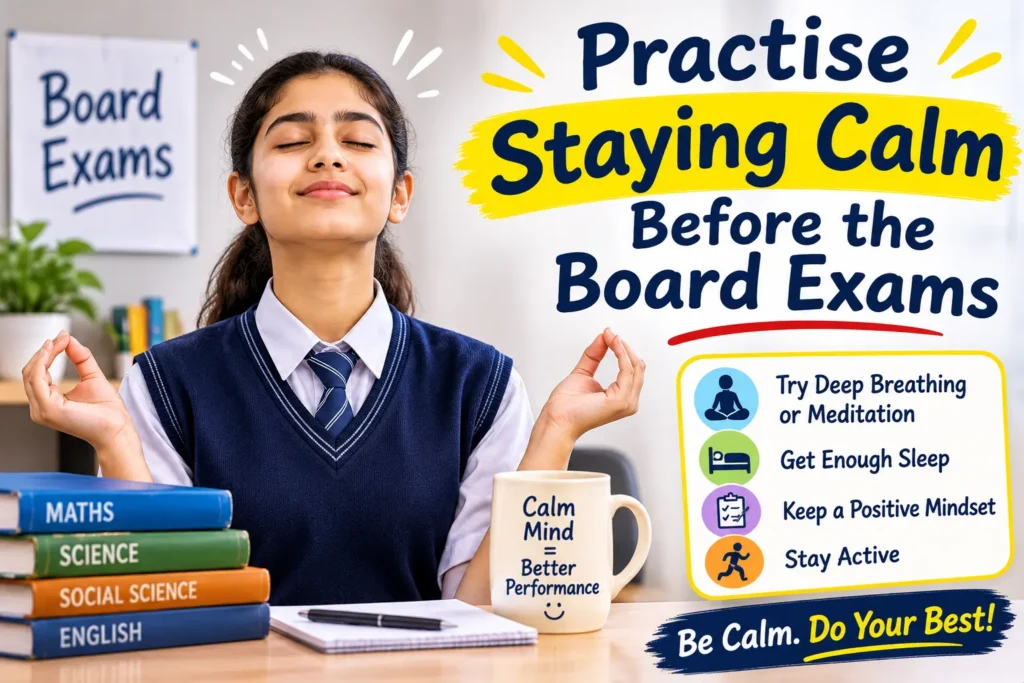
Knowing how to stay calm during exam papers is a skill, and like any skill it works better under pressure if you’ve practised it.
- Practise the breathing daily for two or three minutes, so it feels natural on the day.
- Do timed mock papers at 10:30 am in a quiet room. The more the real exam feels familiar, the less your body treats it as a threat.
- Rehearse a blank moment. In a mock paper, deliberately skip a question, do the reset, and come back. You’ll know the routine works.
- Replace worst-case thoughts. “If I blank, I’ll fail” becomes “If I blank, I’ll breathe, move on and come back.”
When nerves are more than nerves
Feeling nervous before exam day is normal and can even help you focus. But if anxiety stops you studying for days, causes panic attacks, or leaves you unable to sleep or eat, talk to a parent, teacher or school counsellor. UNICEF India’s advice on exam anxiety also suggests talking about your worries with people you trust and not ignoring physical symptoms such as headaches or stomach aches.
You can call Tele-MANAS, the government’s free mental health helpline, at any time on 14416. If you ever feel you can’t keep yourself safe, get help the same day: call Tele-MANAS, talk to a doctor, or call 112 in an emergency.
Frequently asked questions
How to stay calm during exam time if I feel panic?
Stop writing, breathe in slowly for four counts and out for six, five or six times. Feel your feet on the floor, then move to a question you know. Come back to the hard question later.
What should I do if my mind goes blank in an exam?
Don’t force it. Do the 60-second breathing reset, answer a question you’re sure of, and return later. Jot down any related keyword or formula first, as that often brings the rest back.
Why do I forget answers in the exam even after studying?
Stress temporarily makes it harder to recall what you know. Calming your body with slow breathing, practising under exam conditions, and sleeping well all make blanking out less likely.
How can I calm my nerves the night before an exam?
Do a short, light revision, pack your bag, avoid screens for the last hour, and go to bed at your usual time. Writing tomorrow’s plan on paper can stop it going round in your head.
Is it normal to feel nervous before board exams?
Yes. Most students feel nervous, and a little nervousness can help you focus. If anxiety is stopping you from studying, sleeping or eating, talk to someone you trust or call Tele-MANAS on 14416.
About this guide
This guide on how to stay calm during exam time gives general information, not medical advice. We used NHS guidance on breathing exercises for stress, UNICEF India’s advice on exam anxiety, and CBSE and CISCE exam-day arrangements for 2027. Last updated: November 2026.
Free support in India: Tele-MANAS is free and available 24×7 on 14416 or 1-800-891-4416. More details are on the Tele-MANAS website.