









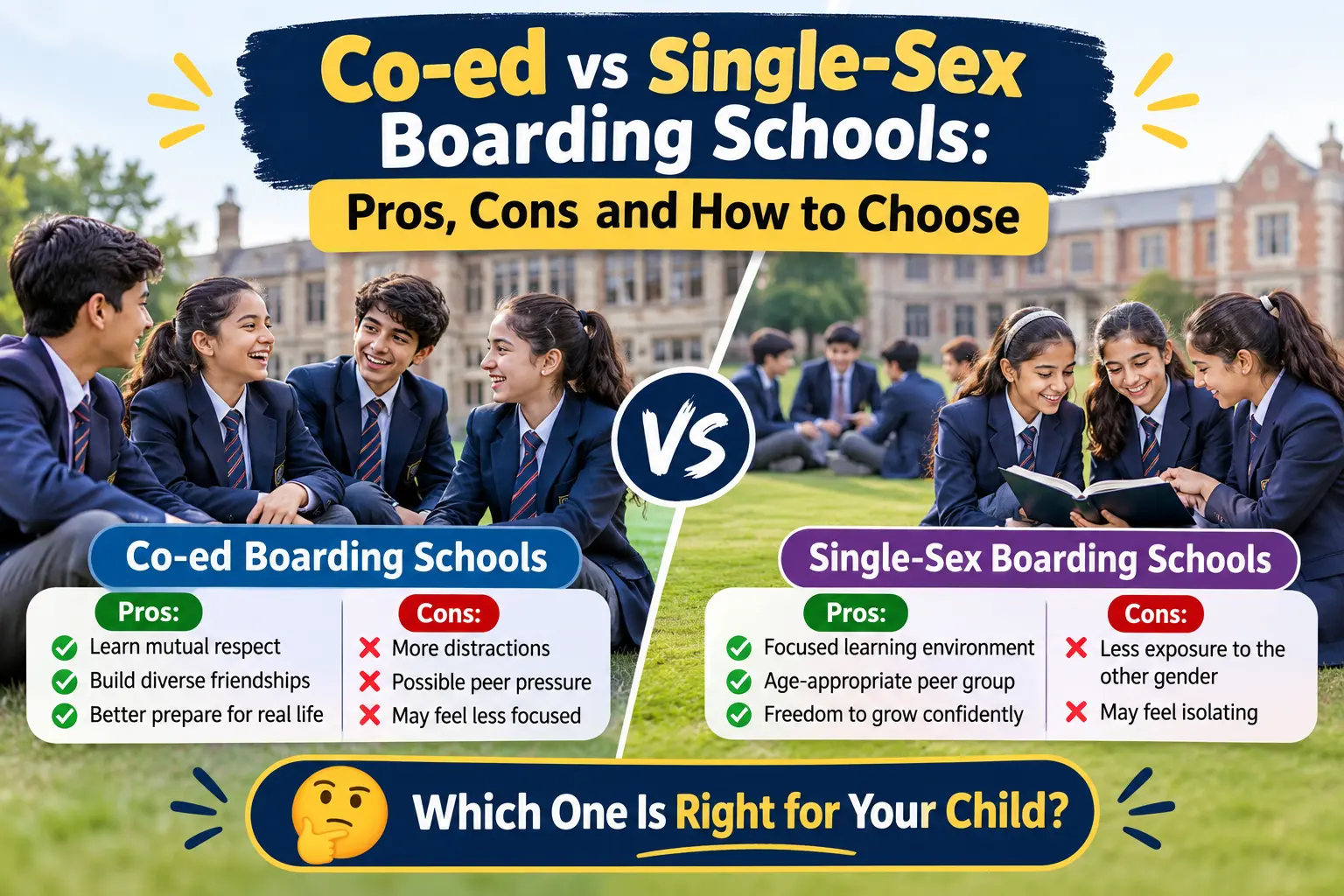
Co-ed vs single-sex boarding school: which is better? Research suggests neither type gives children a clear academic advantage on its own. The right choice depends on your child’s personality, the particular school, and what you want from boarding beyond marks. A well-run school of either kind is a better choice than the “right” type run badly.
This guide sets out what the research actually shows, the real pros and cons of each, how many of each type there are in India on our lists, and questions to help you decide. If you’re still at the stage of deciding on boarding at all, read our complete guide to boarding school first.
Co-ed vs single-sex boarding school: what the research says
The largest review of the question, published in 2014 in the journal Psychological Bulletin, combined 184 studies covering more than 1.6 million students from around the world. Its authors concluded that the advantages of single-sex schooling were small to non-existent once studies controlled for differences between students, according to the American Psychological Association’s summary. Girls in single-sex schools didn’t show higher educational aspirations either, and studies of co-ed schools that taught some subjects in single-sex classes found no significant benefit for boys or girls.
Why do single-sex schools sometimes post better results, then? Often because of who attends them. Families who choose them may have more resources, and some of the schools are highly selective. When researchers compare similar students, most of the gap disappears.
The research is mostly from outside India, so treat it as a guide, not the final word. What it does tell parents is useful: don’t choose a school on the assumption that its type alone will raise your child’s marks.
How many of each type are there?
Co-ed boarding schools are the most common in India. Here’s how the schools with boarding on EdulistIndia’s lists break down.
| List | Girls’ boarding | Boys’ boarding | Co-ed boarding
|
|---|---|---|---|
| India (national list) | 13 | 12 | 26 |
| Dehradun | 6 | 3 | 30 |
| Mussoorie | 4 | 2 | 7 |
| Shimla | 2 | 1 | 11 |
In Delhi NCR, every school with boarding on our list is co-ed. So if you want a single-sex boarding school, you’ll usually be looking at hill towns such as Dehradun and Mussoorie, or schools elsewhere in India.
Single-sex boarding schools: pros and cons
Pros
- Some children feel freer. Shy children, or those who worry about what the other sex thinks, may speak up more in class.
- Fewer distractions in the early teens, some parents feel, although research doesn’t show this raises marks on its own.
- Strong traditions and identity. Many of India’s oldest boarding schools are single-sex, with long-established house systems.
- Simpler boarding arrangements, with one set of house rules for the whole school.
Cons
- Less everyday practice working and making friends with the other sex, which children will need at college and work.
- Stereotypes can linger. One of the 2014 review’s authors has warned that separating children by sex can feed gender stereotypes.
- Fewer schools to choose from, so you may compromise on location, board or fees.
- A bigger adjustment later for some children moving to a co-ed college.
Co-ed boarding schools: pros and cons
Pros
- Closer to real life. Boys and girls learn, play and lead together, as they will later.
- More choice. Most boarding schools are co-ed, across every board and fee level.
- Siblings can attend together, which makes visits, travel and settling in easier.
- A wider range of views in class discussions, clubs and student leadership.
Cons
- More supervision is needed, with separate boarding houses and clear rules. Ask how the school manages this.
- Some children feel self-conscious, especially in the early teens.
- Quality varies. A co-ed school needs strong pastoral care and a clear code of conduct to work well.
Co-ed vs single-sex boarding school: common myths

Parents hear a lot of confident claims about the co-ed vs single-sex boarding school choice. A few worth questioning:
- “Girls do better in maths and science without boys.” The 2014 review found this “girl power” idea wasn’t supported when similar students were compared.
- “Boys are more disciplined in boys’ schools.” Discipline depends far more on the school’s rules, staff and house system than on who is in the class.
- “Co-ed schools are less safe.” Safety comes from supervision, separate boarding houses, staff checks and clear policies, whichever type of school it is.
- “Single-sex schools don’t let children meet the other sex at all.” Many hold joint events, debates or sports with other schools. Ask what each school does.
Which suits your child?
In any co-ed vs single-sex boarding school decision, start with your child rather than the label. These questions can help:
- How does your child behave in mixed groups? Confident, or quieter than usual?
- What does your child want? Older children often have a clear view. Ask them, and listen.
- Do you have children of both sexes? One co-ed school may be simpler for the family.
- Which schools fit your board, budget and location? Narrow down on these first; the co-ed or single-sex choice may then make itself.
- How does each school handle the things you’re worried about? Supervision, friendships, phones and discipline matter more than the type.
Questions to ask either type of school
- How are boarding houses organised, and who supervises them at night?
- What is the code of conduct between students, and how is it enforced?
- How does the school build confidence in quieter children?
- For single-sex schools: what activities do students share with other schools?
- For co-ed schools: are boarding houses fully separate, and how are common areas supervised?
- Can I see the child protection and anti-bullying policies?
For a fuller list, use our 25 questions to ask when visiting a boarding school, and run each school through our checklist for choosing a boarding school.
Start your shortlist
You can compare the options on EdulistIndia by type: girls’ boarding schools in India, boys’ boarding schools in India and co-ed boarding schools in India, each with fees, boards and entry classes.
Frequently asked questions
Is a co-ed or single-sex boarding school better?
Neither is better for every child. A large 2014 review of 184 studies found little academic advantage for single-sex schools once similar students were compared. Choose the school that best fits your child, budget and board.
Do girls do better in girls’ boarding schools?
The 2014 review found that girls’ results and aspirations were not meaningfully higher in single-sex schools when studies compared similar students. Some girls feel more confident in a girls’ school, so your daughter’s own view matters.
Are co-ed boarding schools safe?
A well-run co-ed boarding school is safe when it has separate boarding houses, staff on duty at night, a clear code of conduct and written child protection policies. Ask to see these before you apply.
At what age does single-sex schooling matter most?
Many parents feel most strongly about it in the early teens. If you’re unsure, consider your child’s comfort in mixed groups at that age, and talk to current parents at both kinds of school.
Can my child move from a single-sex to a co-ed school later?
Yes. Many students change at Class 11. It’s a common entry point at many boarding schools, and good schools have a settling-in plan for new students.
How we put this guide together
To compare co-ed vs single-sex boarding school options, we used the 2014 meta-analysis by Pahlke, Hyde and Allison as summarised by the American Psychological Association, and EdulistIndia’s own counts of boarding schools in India, Dehradun, Mussoorie, Shimla and Delhi NCR. Last updated: November 2026.