








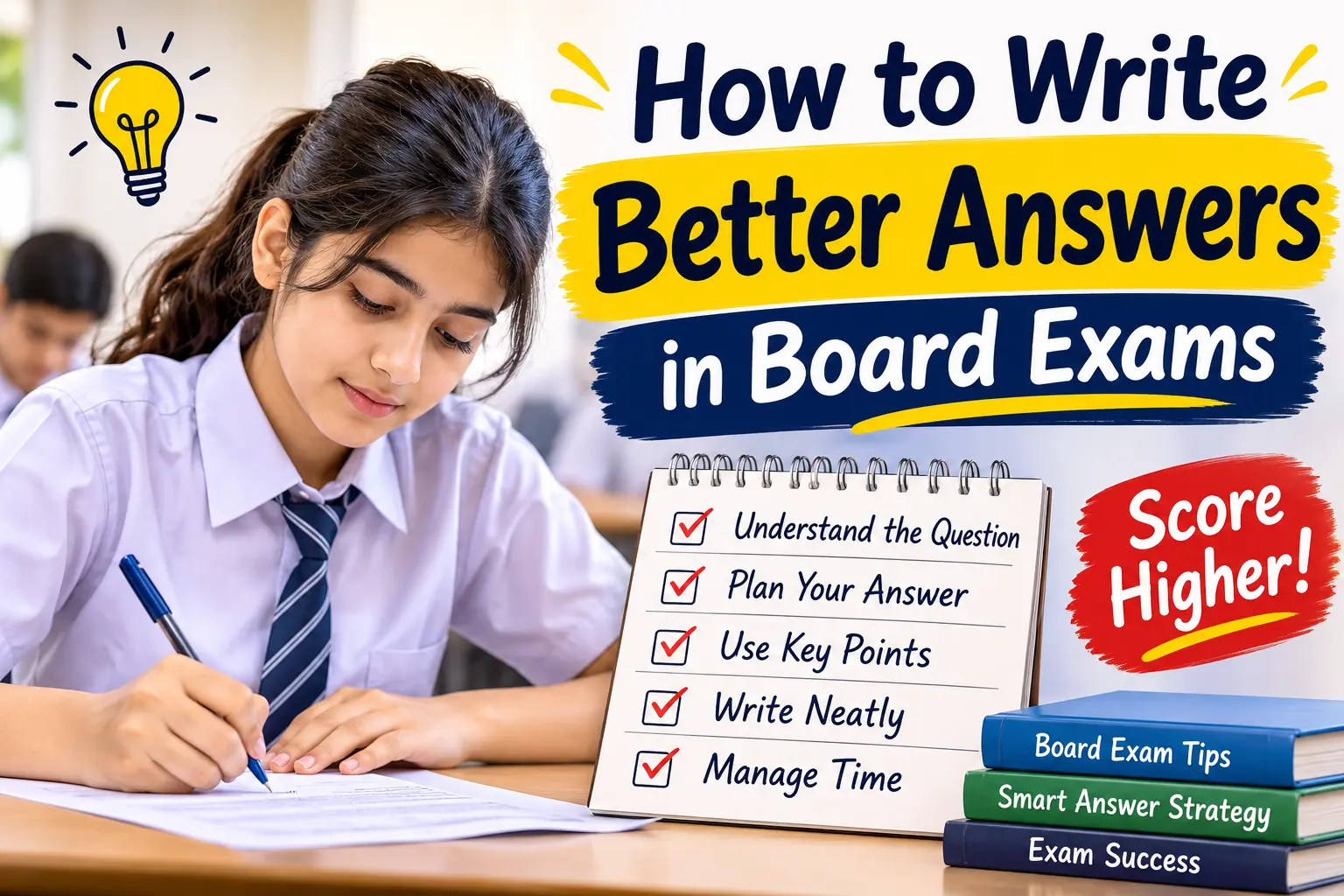
Knowing how to write answers in board exam papers can add marks without learning a single extra chapter. The rules are simple: match the length to the marks, answer exactly what’s asked, use the keywords from your textbook, show every step, and present it so an examiner can find the points quickly. Examiners mark against a marking scheme, so the closer your answer matches it, the more marks you get.
This guide shows how to plan answers by marks, what CBSE’s marking schemes reward, subject-by-subject tips, and the mistakes that cost the most marks. It builds on our board exam study plan.
How examiners mark your answers
Board examiners check many answer sheets against a marking scheme. That scheme lists the points, steps and keywords that earn marks for each question, often split into half-marks and single marks. CBSE publishes marking schemes with its official sample papers for Class 10 and Class 12, and reading a few of them is the fastest way to learn what examiners look for.
Three things follow from that:
- Points earn marks, not length. A long answer that misses the key points scores less than a short one that hits them.
- Steps earn marks. In Maths and numericals, the method usually carries marks even if the final answer is wrong.
- Easy-to-find points get noticed. Clear headings, numbered points and underlined keywords help the examiner see everything you’ve written.
How to write answers in board exam papers: length by marks
Use the marks as your guide to length and structure. If the paper gives a word limit, follow that instead.
| Marks | What a good answer looks like
|
|---|---|
| 1 mark | One word, one line, or the correct option. No explanation needed. |
| 2 marks | Two clear points, or a short definition plus an example. About 2 to 4 lines. |
| 3 marks | Three points, or a short explanation with a diagram or example. About 5 to 7 lines. |
| 4 to 5 marks | A one-line opening, four or five points under clear headings, a diagram or table where useful, and a one-line conclusion. |
| Case-based or source-based | Read the passage first, answer each part separately, and use details from the passage in your answers. |
Time matters too. A three-hour, 80-mark paper gives you a little over two minutes a mark, so a 5-mark answer deserves about 10 to 12 minutes, not 25.
A simple structure for long answers
- Start with the answer. One line that directly answers the question. No long introduction.
- Give your points. Number them or use short headings, one idea per point.
- Add support. A labelled diagram, a flowchart, a table, an example or a date, wherever it fits.
- Close in one line. A short conclusion or summary, especially in Social Science and English.
Underline the key terms in each point with a pencil or the same pen. Don’t underline whole sentences, or nothing stands out.
An example: a weak answer and a strong one
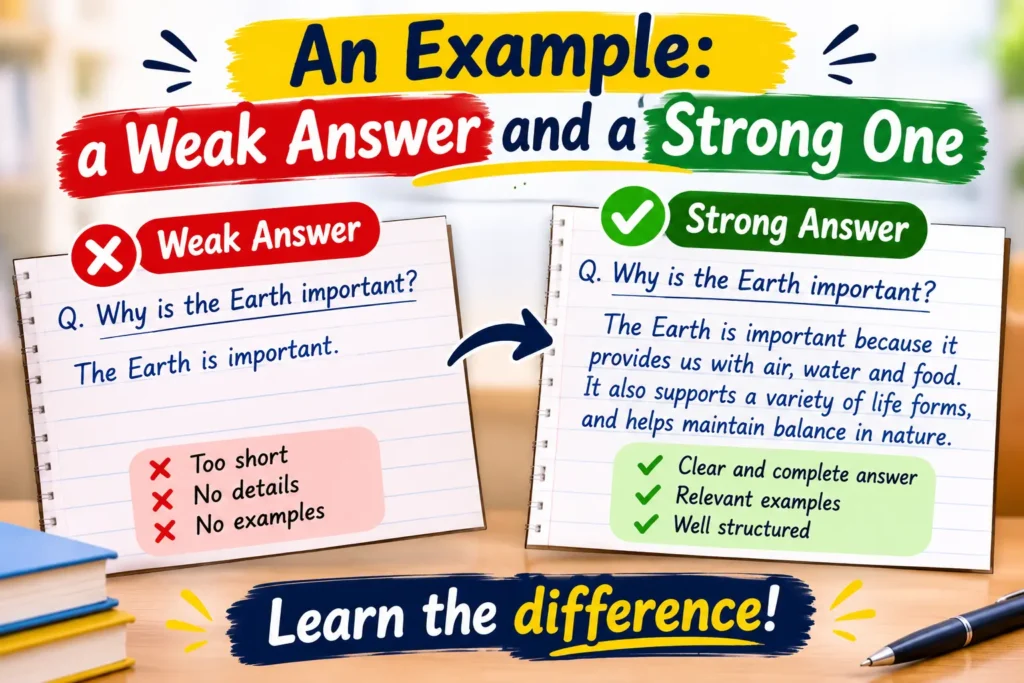
Here’s how to write answers in board exam style, using a 3-mark Science question: “State three differences between arteries and veins.”
Weak answer: “Arteries and veins are blood vessels. Arteries are big and carry blood. Veins are blue and also carry blood around the body to different organs.” This is one long sentence, with no clear differences and vague words, so it scores little.
Strong answer:
| Arteries | Veins
|
|---|---|
| 1. Carry blood away from the heart | 1. Carry blood to the heart |
| 2. Have thick, elastic walls | 2. Have thinner walls |
| 3. Do not have valves | 3. Have valves to stop blood flowing backwards |
The strong answer gives exactly three differences, pairs them point by point, and uses the textbook terms. An examiner can award all three marks in seconds. A table like this works for any “differentiate” or “compare” question.
Subject-wise tips
Mathematics
- Write every step, including the formula you’re using. Method marks add up.
- Draw neat figures for geometry and mensuration, and write the “given” and “to prove” for proofs.
- Box the final answer and write the units.
- If you’re stuck, write what you know: the formula, the first step. It can still earn a mark.
Science
- Use the exact scientific terms from NCERT.
- Draw diagrams in pencil and label them clearly; many questions give separate marks for labels.
- Balance every chemical equation and write state symbols where needed.
- In numericals, write the formula, put in the values with units, then the answer.
Social Science
- Write in points with the keywords from your textbook: names, dates, terms.
- For “explain” questions, give the reason, not just the fact.
- Practise map work separately and mark places neatly.
- For source-based questions, quote or refer to the source in your answer.
English and other languages
- Follow the format for writing tasks such as letters, with the correct layout, and stay within the word limit.
- In literature answers, refer to details from the text, such as a character’s words or an event.
- Keep grammar answers neat; write only what’s asked.
Presentation that helps the examiner
- Write the question number clearly in the margin, exactly as on the paper.
- Start long answers on a fresh line and leave a line between answers.
- Write all parts of one question together.
- Strike out mistakes with a single line. Don’t scribble over them.
- Use the 15 minutes of reading time before writing starts to plan which questions you’ll answer and in what order.
Mistakes that cost the most marks
- Answering a different question from the one asked, because you recognised a familiar topic.
- Writing too much for short questions and running out of time for long ones.
- Answering both options in an internal-choice question. It wastes time, and only one answer counts.
- Leaving questions blank. A partly correct answer can still earn marks; a blank earns none.
- Skipping units, labels or steps that the marking scheme gives marks for.
- No time to check. Keep the last 10 to 15 minutes to read through.
How to practise answer writing
Learning how to write answers in board exam style takes practice, not just reading. Each week, write out five or six answers under time, then mark them yourself against the official marking scheme. Notice which points you missed and which words the scheme uses. Our guide on how to use previous year question papers shows how to fit this into full papers, and you can keep the timing realistic with a study timetable for board exams.
Frequently asked questions
How to write answers in board exam papers for full marks?
Match the length to the marks, answer exactly what’s asked, use textbook keywords, show all steps, and add diagrams or examples where they fit. Then check your answers against the official marking scheme when you practise.
Do neat handwriting and presentation affect marks?
Examiners mark content, but clear writing, numbered points and underlined keywords help them find every point you’ve made. Messy answers risk points being missed, especially in long answers.
How long should a 5-mark answer be?
Usually four or five clear points with a short opening line and conclusion, plus a diagram or example if relevant. Follow any word limit printed on the paper, and spend about 10 to 12 minutes on it.
Should I write answers in points or paragraphs?
Points work best for most Science and Social Science answers because each point is easy to mark. English writing tasks and literature answers usually need short paragraphs.
Is it okay to answer questions out of order?
Yes, as long as each answer is clearly numbered exactly as on the question paper. Many students start with the questions they’re most confident about.
How we put this guide together
We wrote this guide on how to write answers in board exam papers using CBSE’s official 2026-27 sample papers and marking schemes, and compared the answer-writing advice in leading Indian exam-preparation guides. Follow any specific instructions printed on your own question paper. Last updated: November 2026.