

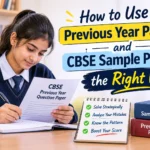

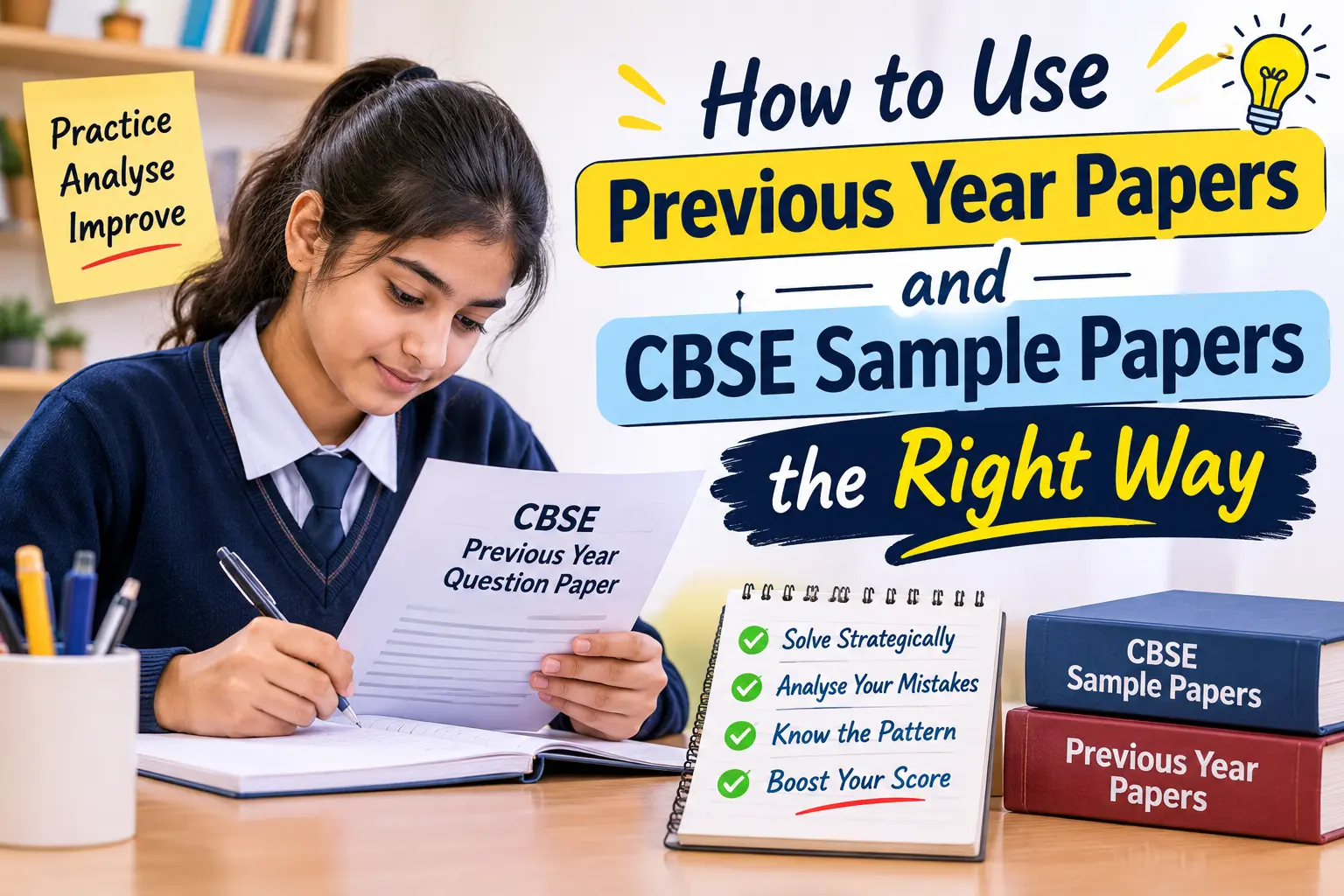
How to use previous year question papers properly: don’t just read them, solve them. Use them first to see which topics come up and how questions are asked, then solve them under a timer, mark your answers against the official marking scheme, and redo every question you got wrong. Used this way, past papers are one of the best ways to prepare for the board exams. Used as reading material, they’re mostly wasted.
This guide explains the difference between previous year papers and sample papers, gives you a five-step method, and shows how many papers to solve between now and the 2027 board exams. It builds on our board exam study plan.
Previous year papers vs sample papers
Knowing how to use previous year question papers starts with knowing what they’re for. Past papers and the CBSE sample paper 2026-27 are both useful, but they do different jobs.
| Previous year papers | Official sample papers
|
|
|---|---|---|
| What they are | Real papers from past board exams | Model papers the board releases for the coming exam |
| Best for | Seeing which topics and question types come up again and again | Practising the exact pattern for 2027 |
| Watch out for | Older papers may follow an older pattern or syllabus | Only one or two per subject, so use them carefully |
| Where to find them | cbse.gov.in (CBSE), cisce.org (ICSE/ISC) | cbseacademic.nic.in (CBSE), cisce.org specimen papers |
CBSE has released its official sample papers and marking schemes for 2026-27 for Class 10 and Class 12. Each notes that there’s no change in the question paper design and assessment pattern for this session, so the official sample paper is your most accurate guide to the 2027 paper. Previous years’ board papers are on the official CBSE website under its board examinations section, and ICSE and ISC students can find specimen papers on cisce.org.
How to use previous year question papers: a five-step method
Step 1: Map the topics
Before you solve anything, go through the last five years of papers for one subject. Note which chapters each question comes from and how many marks it carries. You’ll quickly see which chapters appear every year and which types of question (case-based, diagram, long answer) keep coming back. This becomes your priority list.
Step 2: Practise chapter by chapter
When you finish revising a chapter, solve all the past questions from that chapter straight away, without looking at the answers. This tells you whether you can actually answer board-style questions, not just recognise the topic.
Step 3: Solve full papers under a timer
Once you’ve revised most of the syllabus, solve full papers in three hours, at 10:30 am if you can, the same time as the CBSE board exams. Treat it like a mock test: sit at a table, phone in another room, no breaks. This builds the speed and stamina you’ll need on the day.
Step 4: Mark yourself with the marking scheme
Check your answers against the official CBSE marking scheme (or CISCE’s guidance for ICSE), not a guidebook’s model answers. Look at where marks are given: the steps in a Maths solution, the labels on a diagram, the key terms in a Social Science answer. Be strict with yourself.
Step 5: Log and redo your mistakes
Write every lost mark in a mistakes notebook, with the reason: didn’t know, couldn’t recall, careless slip, ran out of time, or missed presentation marks. A week later, redo those questions without looking. This step is where most of the improvement happens.
Why does this work better than reading? A large review of study techniques found that practice testing is one of the most effective ways to learn, far ahead of rereading, as the Association for Psychological Science’s summary of that research explains. Solving past papers is practice testing.
How many papers to solve, and when
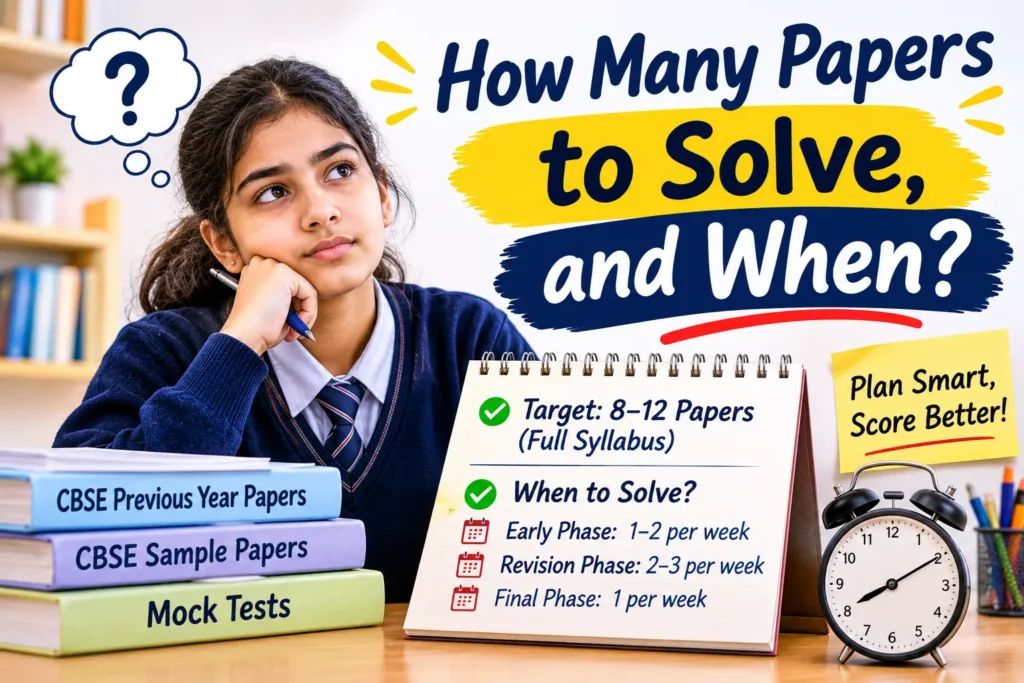
CBSE’s 2027 theory exams start on 16 February, and ICSE Class 10 starts on 15 February. If you’re wondering how many sample papers to solve, here’s how to use previous year question papers and sample papers week by week until then.
| When | What to do | Papers per main subject
|
|---|---|---|
| Late November – December | Map topics; chapter-wise past questions as you revise | Chapter questions from 5 years |
| Before pre-boards | First timed full paper: the official sample paper | 1 |
| January | Full timed papers from recent years, marked strictly | 2 – 3 |
| Study leave (February) | Full papers on alternate days; redo mistakes in between | 2 – 3 |
That adds up to about five to seven full papers per main subject, plus chapter practice. It’s better to solve five papers properly, with marking and corrections, than 15 papers quickly. Your pre-board results will show which subjects need more; our guide on how to prepare for pre-board exams explains how to turn those results into a plan.
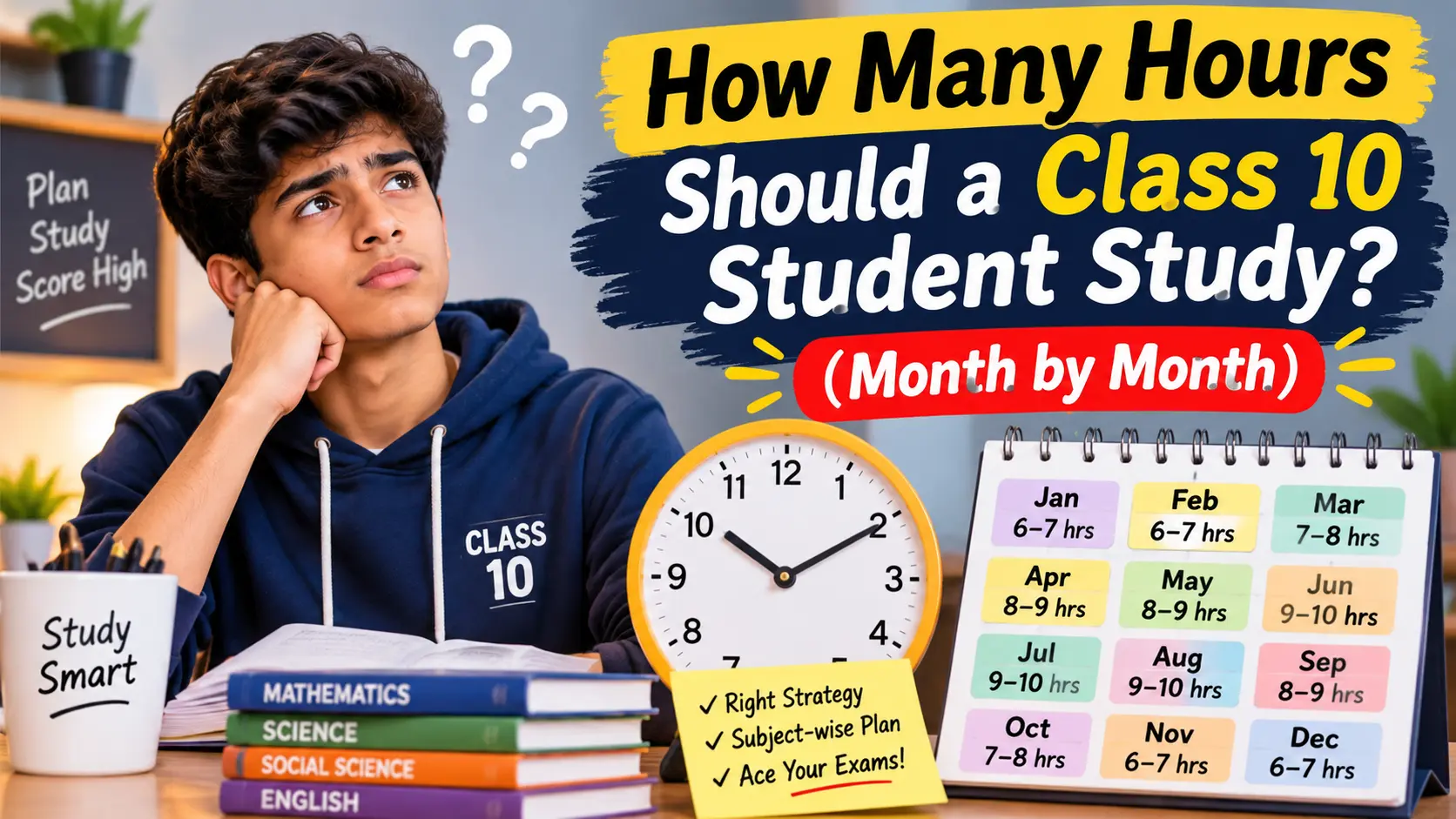
To fit papers into your week, keep one weekend morning for a full paper and the afternoon for marking it, as in the sample timetables in our guide to a study timetable for board exams.
Subject-wise tips
These tips are written with the previous year question papers Class 10 students use most, but they work for Class 12 too.
- Mathematics: past papers show which question types repeat, such as particular theorems, constructions or word problems. Practise those until you can do them quickly, and always write every step.
- Science: note how definitions, diagrams and chemical equations are asked, and learn the exact keywords the marking scheme looks for.
- Social Science: past papers are especially useful for map work and for seeing how long answers are marked point by point.
- English and languages: use past papers to practise writing tasks within the word limit and to time the reading section.
Mistakes to avoid
The biggest mistake in how to use previous year question papers is treating them as reading material. Watch out for these too:
- Reading solutions instead of solving. It feels productive, but you learn far less.
- Using very old papers without checking the syllabus. If a chapter or question type has been removed, skip those questions.
- Trusting “guaranteed questions” lists. Topics repeat, but exact questions rarely do. Learn the whole chapter.
- Skipping the marking. A solved paper you don’t mark tells you very little.
- Leaving all papers for February. By then, there’s no time to fix what the papers reveal.
Frequently asked questions
How many years of previous papers should I solve?
Use five years of papers for topic mapping and chapter practice, and solve about five to seven full papers per main subject under timed conditions. Quality matters more than quantity: mark every paper and redo your mistakes.
Do CBSE questions repeat from previous years?
Exact questions rarely repeat, but topics, question types and the style of asking do. That’s why past papers are so useful for spotting important chapters and practising the way questions are framed.
Should I solve sample papers or previous year papers first?
Start with previous year questions chapter by chapter while you revise. Then solve the official sample paper as your first full timed paper, because it matches the 2027 pattern most closely.
Where can I download official previous year papers?
CBSE publishes past board papers on cbse.gov.in and sample papers with marking schemes on cbseacademic.nic.in. ICSE and ISC students can find specimen papers on cisce.org.
How to use previous year question papers for ICSE?
The method is the same: map the topics across five years, practise chapter by chapter, then solve full papers at the real exam time (most ICSE papers in 2027 start at 10:15 am) and mark them strictly. Use CISCE’s specimen papers for the latest pattern.
When should I start solving previous year question papers?
Start chapter-wise practice as soon as you finish revising each chapter, ideally in November. Begin full timed papers in December or January, once most of the syllabus is covered.
How we put this guide together
To explain how to use previous year question papers, we used CBSE’s official 2026-27 sample papers and marking schemes, CBSE’s and CISCE’s official websites, the 2027 board exam dates, and research on effective study methods summarised by the Association for Psychological Science. Check your school’s and board’s latest instructions too. Last updated: November 2026.