








If you’re asking yourself, “Should I send my child to boarding school?“, the honest answer is: it depends on your child, your reasons and the school you choose. Boarding works very well for children who are ready to live away from home and for families with a clear reason to choose it. It works badly when it’s used to fix a problem at home or when the school isn’t a good fit.
This guide helps you decide. It covers what boarding life in India is really like, the pros and cons, the signs that your child is ready, what it costs, how to check a school, and what to do next if the answer is yes.
Should I send my child to boarding school? The short answer
Most families can answer the question in about ten minutes by going through two short lists.
Boarding is likely a good fit if:
- Your child is curious about boarding, or is asking for it.
- They have spent nights away from home (with grandparents, on a school trip or at a camp) and coped well.
- They can manage daily routines such as getting ready, keeping track of their things and sleeping on time.
- Your family has a clear reason: frequent job transfers, a long commute, or a school whose academics, sport or activities suit your child far better than anything nearby.
- You can afford the full cost for several years, not just the first one.
It’s worth waiting if:
- Your child is anxious about it, or has never slept away from home.
- The main reason is to correct behaviour, punish, or “make them disciplined”.
- The family is going through a big change, such as a move, a bereavement or a separation, and your child needs you close by.
- You haven’t visited the school or spoken to current parents yet.
If most of your answers fall in the first list, boarding is worth serious thought. If more fall in the second, a good day school, or a day boarding school where children stay till evening and go home at night, may suit your child better for now.
What boarding school life in India actually looks like
Parents often picture boarding schools from films and old novels. Life at a residential school in India today is more structured, and usually more connected to home, than that picture suggests.
Full boarding, day boarding and weekly boarding
- Full boarding: children live on campus during term and go home for holidays and some long weekends.
- Day boarding: the term is used in two ways in India. Some schools mean an extended school day (children stay for meals, supervised study and activities, then go home in the evening). Others use it for schools that take both day scholars and boarders. Ask each school which one it means.
- Weekly boarding: a few schools let children board from Monday to Friday and spend weekends at home.
A typical day
Most boarders follow a fixed routine: wake-up and physical training, breakfast, classes, lunch, more classes or activities, games in the evening, supervised study (often called “prep”), dinner and lights out. Weekends bring activities, outings and, at many schools, scheduled phone calls with parents. The routine is the point: it gives children structure without someone at home having to enforce it.
Which boards boarding schools follow
Boarding schools follow every major board. In our own list of 39 boarding schools in Dehradun, for example, 25 follow CBSE, 14 follow ICSE/ISC and 5 offer the IB or Cambridge, and some offer more than one. Choose the board first, then the school, because switching boards later is harder than switching schools.
Boarding school pros and cons
Every family weighs these differently. Here are the main benefits of boarding school and the real drawbacks, side by side.
| Benefits of boarding school | Drawbacks to weigh |
|---|---|
| Independence and self-management at an early age | Less day-to-day time with family |
| A structured routine with supervised study time | Homesickness, especially in the first term |
| Sport, music and activities built into every day | High cost, often for 5 to 10 years |
| Friendships with children from across India and abroad | Less say over daily choices such as food, screen time and friends |
| No daily commute, fewer distractions at home | Quality of care varies a lot between schools |
The benefits are real, but they depend on the school
Independence, routine and activities come from the way a school runs its boarding houses, not from boarding itself. A well-run house with a caring house parent and sensible rules gives children all of these. A poorly run one gives them very little. That’s why checking the school matters as much as the decision to board.
The drawbacks can be managed, but not ignored
Homesickness is the drawback parents worry about most, and it’s common. According to the American Camp Association’s briefing on homesickness research, about 20% of young people report moderate to severe homesickness when away from home, and around 7% report intense homesickness. The same research notes that homesickness is common wherever children spend time away from home, from camps to boarding schools and universities, and that it usually eases as children settle. Preparation makes a big difference, which we cover below.
Is boarding school good for children? Signs your child is ready
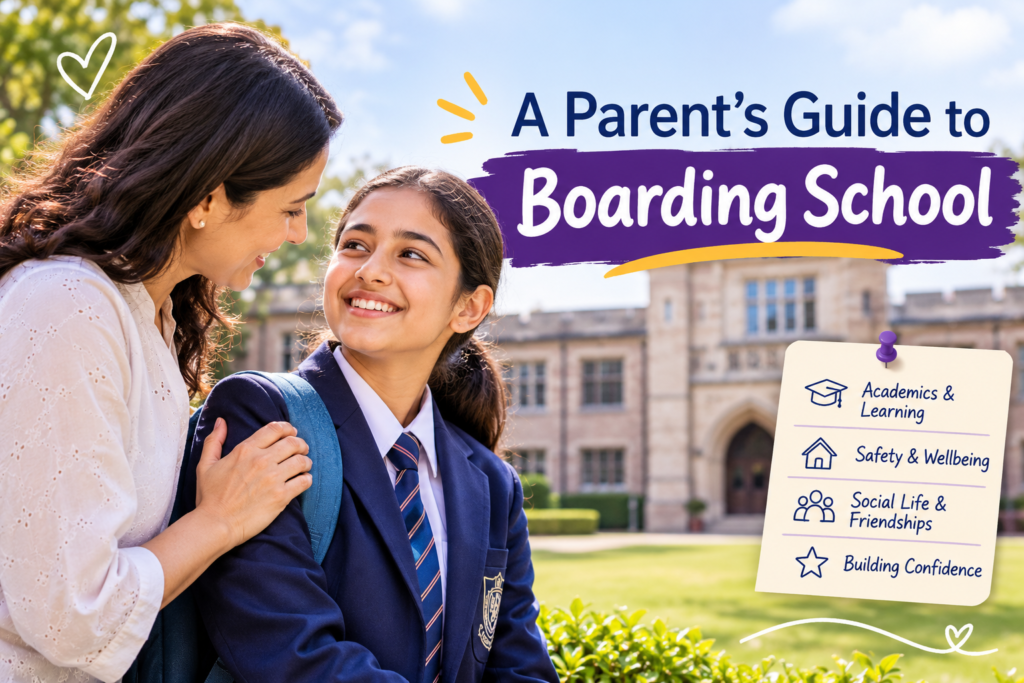
Is boarding school good for children in general? There’s no single answer. For most families, the answer to “should I send my child to boarding school” comes down to readiness, and readiness matters more than age. It shows in everyday behaviour. Look for these signs:
- They have slept away from home and coped: a few nights with relatives or on a school trip without serious distress.
- They manage their own routine: bathing, dressing, packing a bag and keeping track of their belongings.
- They make friends reasonably easily: boarding is a social life as much as a school.
- They can speak up: they’ll tell a teacher or house parent if something is wrong.
- They’re curious about boarding: children who want to go settle much faster than those who feel sent away.
- They’re not going through a major upheaval: a new sibling, a family illness or a recent move can make separation harder.
- They have a realistic picture: they know there will be rules, shared rooms and fixed phone times.
Preparation helps a lot. A report on homesickness research published in Pediatrics found that coaching parents and teaching children simple coping skills before they leave cut the intensity of homesickness by about half. The single biggest mistake, the researchers said, is promising to bring a child home early if they feel homesick, because it keeps their mind on home instead of on settling in.
Good and not-so-good reasons to choose boarding
Before you settle the question “should I send my child to boarding school”, be honest about why you’re asking it. Your reasons are one of the best predictors of whether boarding will work.
Reasons that usually lead to a good outcome
- The school offers something your child genuinely needs: a board, a sport, music, smaller classes or a stronger academic programme that isn’t available near home.
- Your work involves frequent transfers, and boarding gives your child one stable school for several years.
- You live far from good schools, and the daily commute would take hours.
- Your child has asked to board and understands what it means.
Reasons that often backfire
- “It will fix their behaviour.” Boarding is not a correction centre. Children who struggle at home usually need support first, not distance.
- “Everyone in the family went.” Tradition is a fine starting point, but your child is not their cousin.
- “It looks good.” A famous name matters far less than whether the school suits your child.
Are you ready too? Five questions for parents
Children aren’t the only ones who need to be ready. Boarding changes family life for parents as well, and the decision goes more smoothly when you’ve answered these honestly:
- Can we afford it for the whole stay? Most children board for five years or more, and fees usually rise every year.
- Can we travel to the school? Think about parent days, pick-ups at the start and end of term, and getting there quickly if your child is unwell.
- Do both parents agree? Children pick up on doubt at home, and mixed messages make settling harder.
- Are we comfortable sharing day-to-day decisions? House parents and teachers will make many small calls about food, bedtimes and friendships that you’d usually make yourself.
- What’s our plan if it doesn’t work? Knowing you have a good day school as a fallback takes pressure off everyone, even if you never use it.
If you can answer all five with confidence, you’re ready to look seriously at schools.
What is the right age for boarding school?
Many parents and schools suggest that somewhere between about 8 and 13 years is when children settle most easily, but there’s no single right age for boarding school. Schools also set their own entry points. Among the 39 boarding schools in Dehradun on our list, 20 take children from Class 1, 10 start at Class 4, a few such as Welham Girls’ and SelaQui start at Class 6, and The Doon School admits at Class 7 and 8.
Younger children need more hands-on care from house parents, so ask how many children each house parent looks after. Older children settle into routines faster but may find it harder to leave established friendships. Whatever the age, the readiness signs above matter more than the date of birth.
How much does boarding school cost in India?
Boarding school fees in India vary more than almost any other school cost. In Dehradun alone, indicative annual fees on our list range from about ₹60,000 to ₹16,54,000, and 24 of the 39 boarding schools start below ₹3 lakh a year. At the top end, The Doon School’s published 2026-27 fees are ₹14,54,000 for ICSE/ISC and ₹16,54,000 for the IB.
When you compare boarding schools, ask what the fee covers. Tuition, boarding and meals are usually included. These often aren’t:
- One-time admission fees and refundable caution deposits
- Uniforms, bedding, books and stationery
- Travel at the start and end of each term
- School trips, coaching, music lessons and some sports
- Pocket money and medical expenses beyond basic care
Plan for the full number of years your child will board, and expect fees to rise each year. To get a feel for the range, you can compare boarding schools in Dehradun side by side, with boards, entry classes and indicative fees.
How to choose a boarding school you can trust
Once boarding feels right, the next question is which school. Here’s what to check before you shortlist.
Check the board affiliation yourself
A school’s website saying “CBSE” isn’t proof. You can confirm a CBSE school’s affiliation on the board’s official SARAS affiliation portal, using the school’s name or affiliation number. For ICSE/ISC, IB or Cambridge, ask the school for its registration details and check them with the board.
Ask about care, not just facilities
- How many children does each house parent look after, and who is on duty at night?
- Is there a doctor or nurse on campus, and which hospital does the school use?
- What is the school’s child protection policy, and how are complaints handled?
- How does the school prevent ragging and bullying?
- When can children call home, and how often can parents visit?
Visit, and talk to current parents
A campus visit shows you things a brochure can’t: how children talk to staff, the state of the dormitories and washrooms, and the food. Ask the school to put you in touch with two or three current parents, and ask them what they’d change.
When you’re ready to compare options, start with our list of boarding schools across India, filtered by board, gender and fees.
Boarding school vs day school: which suits your family?
| Boarding school | Day school | |
|---|---|---|
| Daily life | Lives on campus with a fixed routine | Goes home every day |
| Parent involvement | Calls, visits and holidays | Daily |
| Study support | Supervised prep every evening | Depends on home and tuition |
| Activities | Built into each day | Mostly after school, if available |
| Typical cost | Higher (tuition, boarding, meals) | Lower, plus transport and tuition |
| Best for | Independent children, families with a clear reason to board | Children who need family close by, families near good schools |
Day boarding sits in between: a longer school day with meals and supervised study, but home every night. It’s a good way to test how your child handles a structured day before committing to full boarding.
How to talk to your child about boarding school
Children cope far better with boarding when they feel part of the decision. A few things help:
- Ask before you tell. Find out what they already think and what worries them.
- Visit together. Let them see the dormitories, meet students and ask their own questions.
- Be honest about the hard parts. Say that missing home is normal and that it usually gets easier.
- Agree a contact plan. Knowing when they’ll next call or see you makes separation feel manageable.
- Don’t promise an escape route. As the research above shows, “you can come home if you don’t like it” makes settling harder.
If you decide yes: what to do next
Many boarding schools open registration for the next academic year between October and January, and popular schools fill their places early. A typical process looks like this:
- Shortlist three to five schools that match your board, budget and your child’s interests.
- Visit and ask the questions above.
- Register before the deadline and note the entrance test date.
- Prepare for the entrance test and interaction: most test English, maths and reasoning at your child’s level.
- Prepare your child for the first term: short stays away from home, packing together, and a clear plan for calls.
So, should I send my child to boarding school? If your child is ready, your reasons are sound and you’ve found a school you trust, boarding can be one of the best decisions you make for them. If any of those three is missing, it’s fine to wait a year and ask the question again.
Frequently asked questions
Is boarding school good for children?
It can be, for the right child at the right school. Children who are ready to live away from home often gain independence, routine and confidence. Children who aren’t ready, or who are sent for the wrong reasons, can struggle. Readiness, your reasons and the quality of care matter more than boarding itself.
What is the right age to send a child to boarding school?
There’s no single right age. Many families find children settle most easily between about 8 and 13, and schools have their own entry classes, commonly Class 1, 4, 6 or 7. Look at your child’s readiness first: sleeping away from home, managing routines and wanting to go.
Will my child feel homesick in boarding school?
Most children miss home at first, and that’s normal. Research shows about 1 in 5 young people feel moderate to severe homesickness, which usually eases as they settle. Preparing your child before they leave and agreeing a regular call routine both help.
Are boarding schools in India safe?
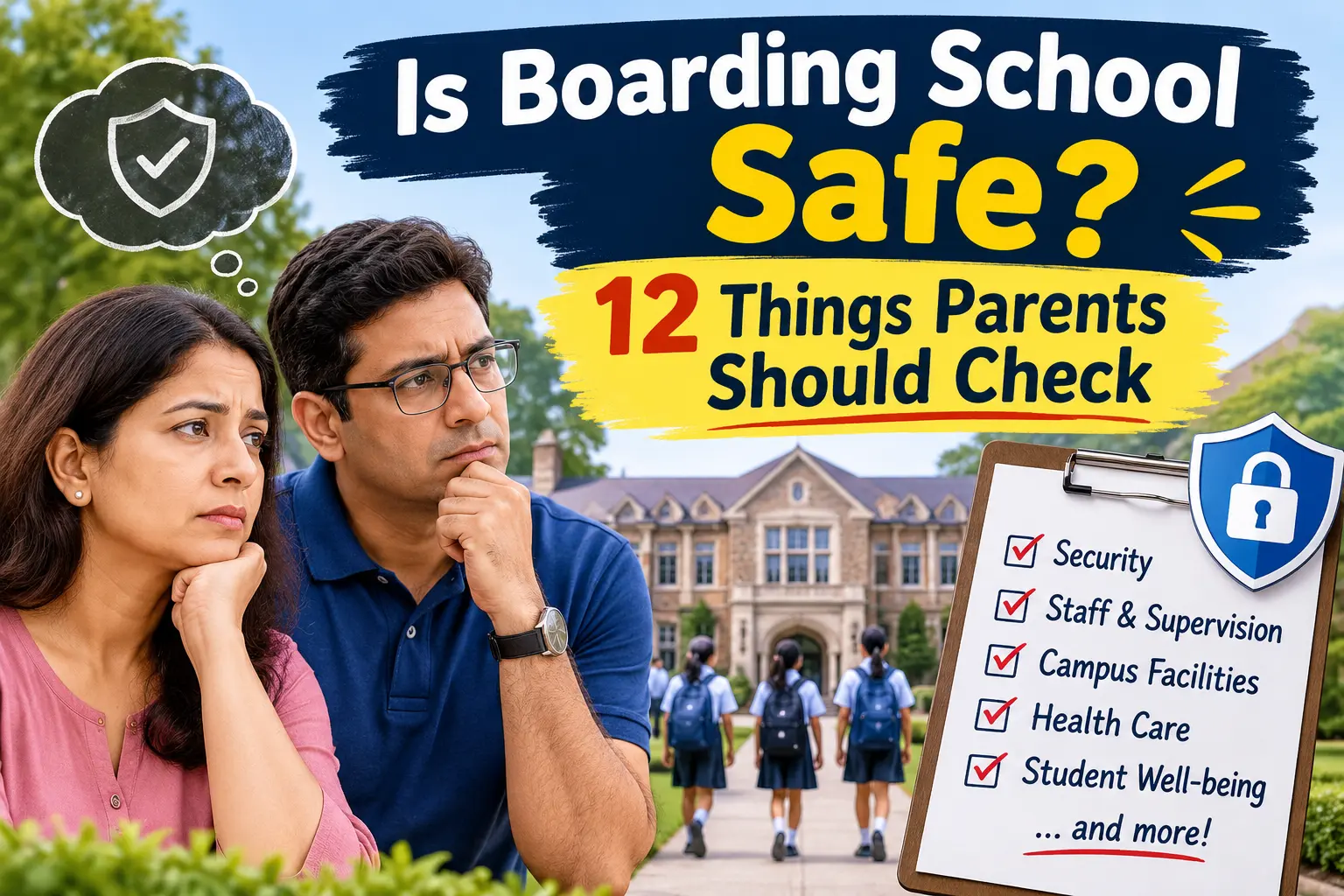
Most established boarding schools have resident house staff, secure campuses and on-site medical care, but standards vary. Ask about night supervision, the child protection policy, anti-ragging rules and how complaints are handled, and visit before you decide.
How much does a boarding school cost in India?
Annual fees range widely, from under ₹1 lakh to over ₹16 lakh a year. In Dehradun, most boarding schools on our list start below ₹3 lakh. Always ask what’s included, and budget for admission fees, uniforms, travel and trips.
How often can parents visit a child in boarding school?
It depends on the school. Many allow visits on set weekends, have parent days each term, and schedule weekly phone or video calls. Ask for the exact policy before you apply, because it varies a lot.
Should I send my child to boarding school if they don’t want to go?
Usually not straight away. Children who feel sent away settle more slowly. Visit schools together, listen to their worries and give it time. Many children change their minds after a visit or a short stay away, and a year’s wait costs far less than an unhappy start.
Will boarding school affect my relationship with my child?
Not if you stay in regular touch. Many families find time together becomes more focused during holidays. Keep calls predictable, listen more than you advise, and stay involved in decisions about their school life.
How we put this guide together
We wrote this guide to help parents answer “should I send my child to boarding school” with facts rather than brochures. It draws on our listing data for boarding schools across India (boards, entry classes and indicative fees taken from school websites and published information), published research on homesickness, and official board resources. Fees change every year, so please confirm the latest figures directly with each school. Last updated: November 2026.

7 thoughts on “Should I Send My Child to Boarding School? A Parent’s Guide”