







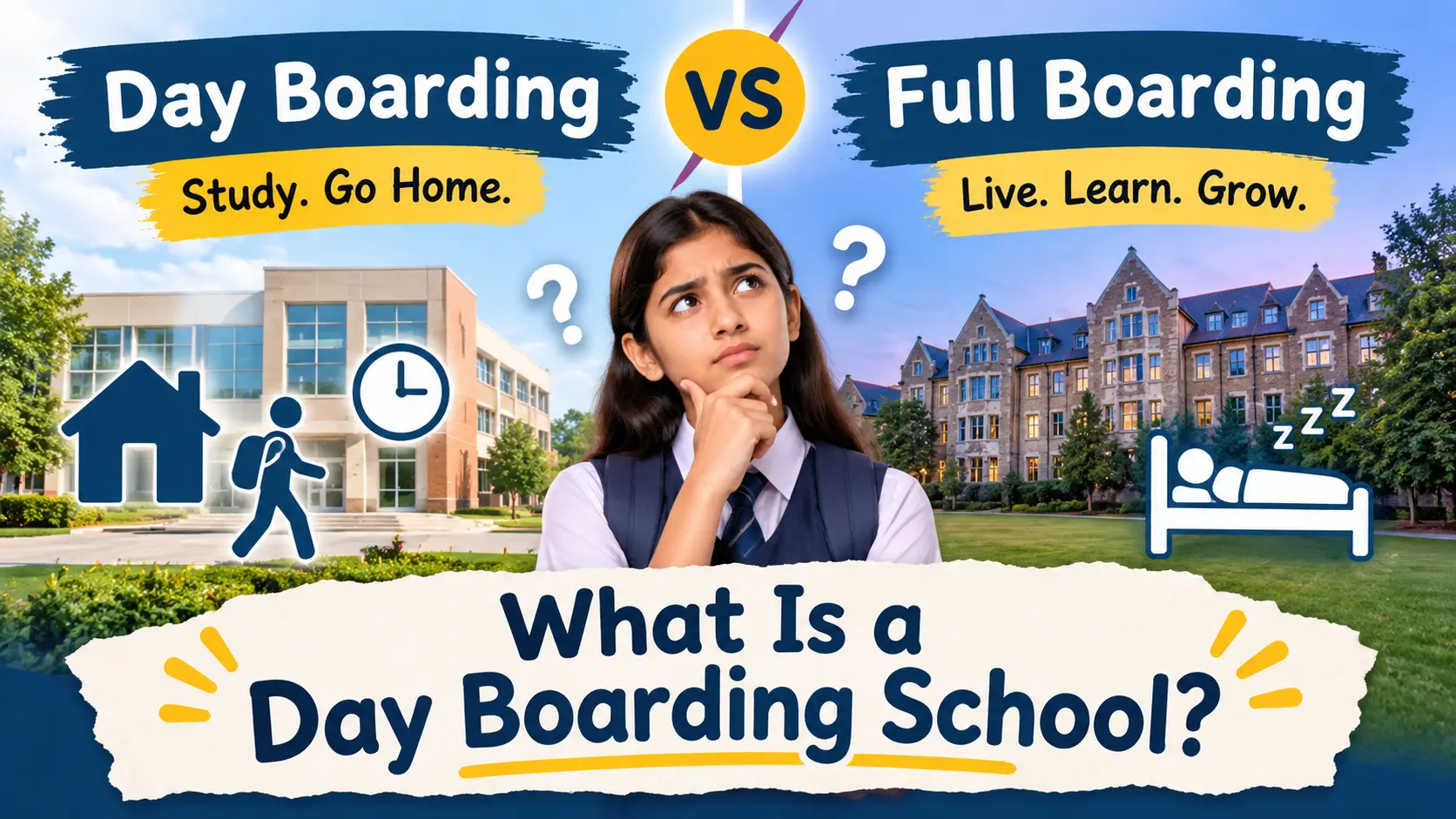
What is a day boarding school? In most Indian cities, it’s a school where your child stays on campus for an extended day, usually from morning until about 5 or 6 pm, with lunch, supervised study and sports included, and then comes home to sleep. But the term is used in a second way too: some schools call themselves “day boarding” simply because they take both day scholars and boarders. Before you compare fees or timings, find out which one a school means.
This guide explains both meanings, compares day boarding with full boarding and a regular day school, and gives you a list of questions to ask before you sign up. If you’re still deciding whether boarding of any kind is right for your family, start with our complete boarding school guide for parents.
What is a day boarding school? The short answer
In India, there are two correct answers to the question “what is a day boarding school?”, depending on who you ask.
Meaning 1: an extended school day
This is what most parents mean. The child attends normal classes, then stays on for lunch, a rest, supervised homework or study time, and sports or activities. Parents pick the child up in the evening, and the child sleeps at home. There’s no dormitory and no overnight stay.
A typical example is NIMT Beacon School in Ghaziabad, whose day boarding programme runs from 8 am to 5 pm and includes breakfast, a hot lunch and evening snacks, homework done at school under teacher supervision, and afternoon sports and activities. Timings and what’s included vary a lot from school to school, so always ask for the exact schedule.
The idea isn’t only Indian. In British boarding schools, a “day boarder” is a pupil who stays late for meals, activities and prep in the boarding house but doesn’t sleep there, as this explainer on day boarders puts it.
Meaning 2: a school with both day scholars and boarders
Many residential schools also admit children who live nearby and go home every day. Some of these schools, and some school directories, describe themselves as “day boarding” or “day-cum-boarding” schools. Here the term describes the school, not your child’s daily routine. Your child could be a full boarder or a day scholar at the same school.
So if a school says it’s a day boarding school, ask a simple follow-up: “Do you mean my child stays until the evening and goes home, or that you have both day scholars and boarders?”
How EdulistIndia uses the term
On EdulistIndia, we use the second meaning. A school we label “day boarding” takes both day scholars and boarders, so families can choose either option. A school we label “full boarding” is fully residential.
In Dehradun, for example, our list has 39 schools with boarding: 18 are fully residential and 21 also take day scholars. You can see those 21 on our page of day boarding schools in Dehradun, and there are 12 on our list of day boarding schools in Delhi NCR. If what you want is an extended day (meaning 1), check each school’s after-hours programme with the school directly, because it isn’t the same at every campus.
Day boarding vs full boarding vs day school
Here’s how the three most common options compare, using the extended-day meaning of day boarding. For most families, this table settles the day boarding vs boarding question faster than any brochure.
| Day school | Day boarding | Full boarding
|
|
|---|---|---|---|
| Hours at school | About 6 to 7 hours | About 8 to 10 hours | Lives on campus during term |
| Sleeps at | Home | Home | School dormitory |
| Meals at school | Usually none, or tiffin | Lunch and snacks, sometimes breakfast | All meals |
| Homework | At home | Mostly done at school, supervised | Done in evening “prep” |
| Family time | Most | Evenings and weekends | Holidays, visits and outings |
| Cost | Lowest | Day fee plus a day boarding charge | Highest (tuition plus boarding and lodging) |
| Often suits | Families with time in the afternoons | Working parents, long commutes | Children ready to live away from home |
The cost line is the one to check carefully. Many schools bill day boarding as a separate charge on top of tuition, for the meals and extra supervised hours, so ask for the full annual figure, not just the tuition fee.
What a day boarding day usually looks like
Day boarding school timings differ from campus to campus, but most extended-day programmes follow a pattern like this one. Treat it as an example, not a standard.
| Time | What happens
|
|---|---|
| 7:45 – 8:00 am | Arrival (some schools serve breakfast) |
| 8:00 am – 2:00 pm | Regular classes with the rest of the school |
| 2:00 – 3:00 pm | Lunch and a short rest |
| 3:00 – 4:00 pm | Supervised homework or study with a teacher |
| 4:00 – 5:00 pm | Sports, games, music, art or clubs |
| 5:00 – 6:00 pm | Snack, then pick-up or the school bus home |
So when parents ask what is a day boarding school day really like, the honest answer is “long”: usually 8 to 10 hours, with most homework finished before your child gets home.
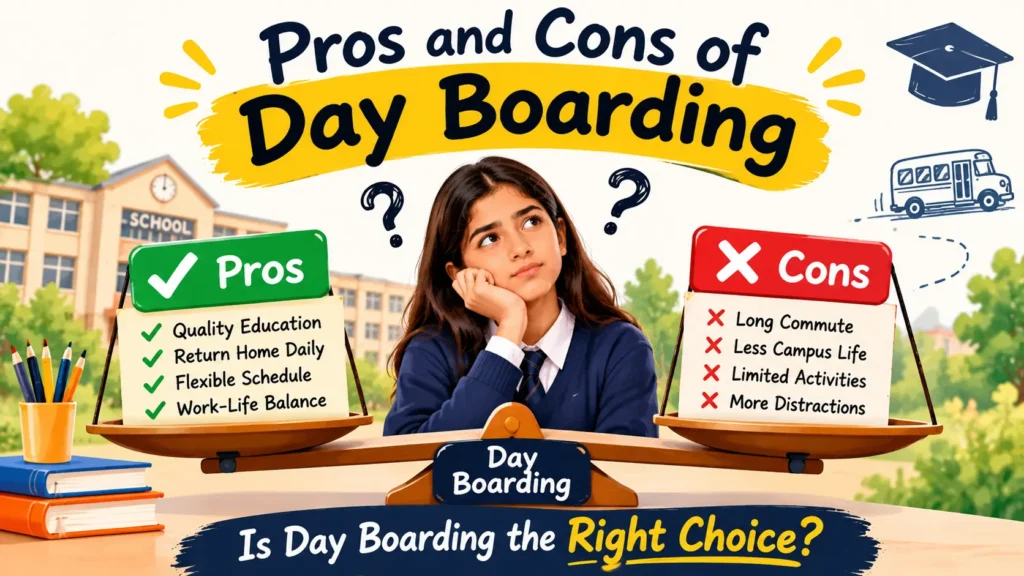
Pros and cons of day boarding
What works well
- Homework gets done with help. Supervised study time means fewer evening battles over homework, and a teacher is there for doubts.
- Working parents get cover. Your child is in a safe, supervised place until you finish work.
- More sport and activities. The extra hours usually include games and clubs that many day schools can’t fit in.
- Your child still comes home. You keep the evening routine, family dinner and weekends together.
- A gentle step towards boarding. For some children, an extended day is a useful trial before full boarding later.
What to watch
- Long days are tiring, especially for younger children. Watch for a child who is exhausted every evening.
- Less unstructured time. Free play and rest at home matter too.
- Quality varies. In some schools, “supervised study” means a qualified teacher; in others, it’s an attendant watching a room.
- Extra cost and long commitment. Some schools don’t let you opt out mid-year once you’ve signed up.
Who day boarding suits
Day boarding tends to work for:
- Families where both parents work and no one is at home in the afternoon.
- Children with a long trip to school, who would otherwise spend the evening travelling and then starting homework late.
- Children who do better with structure and need help to finish homework.
- Families who like the idea of boarding but don’t want their child sleeping away from home yet.
If you’re weighing up when your child might be ready for full boarding, our class-by-class guide to the right age for boarding school explains what changes at each entry point.
Weekly boarding and other in-between options
A few schools offer weekly boarding, where children board from Monday to Friday and go home every weekend. Others allow occasional overnight stays, for example during exam weeks or when parents travel. These options are less common in India than in the UK, so ask each school what it actually offers rather than assuming.
Questions to ask before choosing day boarding
- Which meaning do you use: an extended day, or a school with both day scholars and boarders?
- What are the exact start and pick-up times, and what happens if I’m late?
- Which meals are included, and can I see a week’s menu?
- Who supervises study time: a subject teacher or a general attendant? How many children per adult?
- Is homework checked, or only supervised?
- Which sports and activities can my child’s age group actually join?
- Is school transport available after day boarding hours?
- What’s the full annual cost, including the day boarding charge?
- Can we stop day boarding mid-year if it isn’t working?
- What happens if my child falls ill in the afternoon?
Frequently asked questions
What is a day boarding school in simple words?
It’s a school where your child stays for an extended day, usually until 5 or 6 pm, with meals, supervised study and activities, then goes home at night. Some schools also use the term for a school that takes both day scholars and boarders, so ask which one they mean.
What is day boarding school timing usually?
Most extended-day programmes run from around 8 am to between 4:30 and 6 pm, depending on the school and the child’s class. Ask for the exact pick-up time and the late pick-up rule before you enrol.
Is day boarding better than full boarding?
Neither is better for every child. Day boarding keeps your child at home every night and suits working parents. Full boarding suits children who are ready to live away from home and families who want a fully residential school.
Do day boarders stay at school at night?
No. In the extended-day meaning, day boarders go home every evening. They don’t have a bed in the boarding house, though some schools may allow an occasional overnight stay.
Is day boarding more expensive than a day school?
Usually yes, because meals and extra supervised hours are included. Many schools charge it separately on top of tuition. It’s normally much cheaper than full boarding, which includes lodging and all meals.
Which age is best for day boarding?
Many schools offer it from the junior classes onwards. Younger children can find long days tiring, so look at your child’s energy, the school’s rest time, and how far you live from school.
How we put this guide together
To answer what is a day boarding school, we compared how Indian schools describe their day boarding programmes on their own websites with how the term is used in UK boarding, and how EdulistIndia labels schools in its own listings. Our school counts come from EdulistIndia’s school data for Dehradun and Delhi NCR. Timings, meals and fees differ between schools, so confirm them with each school. Last updated: November 2026.