

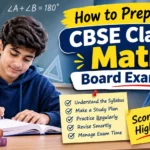



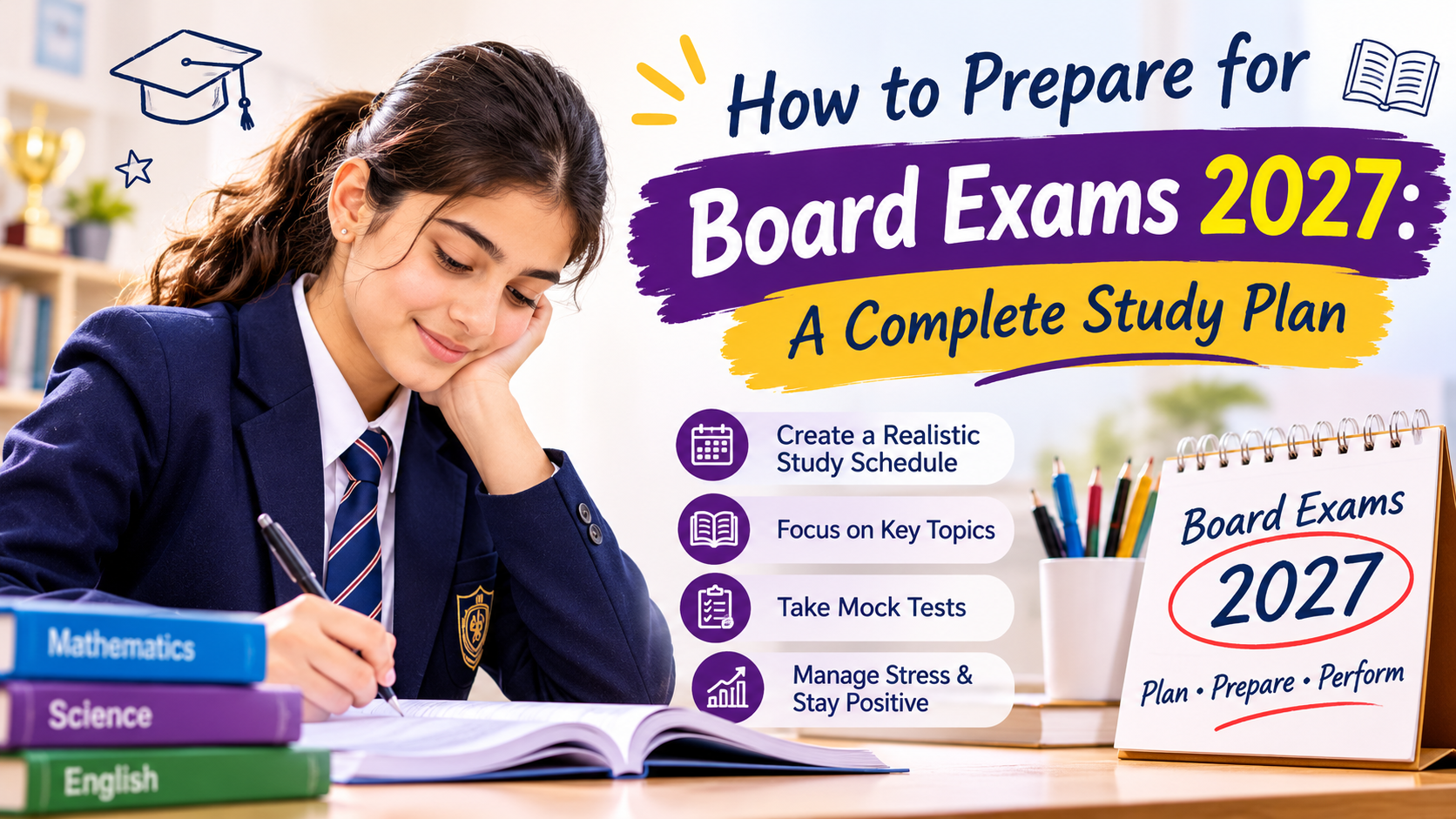
Knowing how to prepare for board exams is less about studying fourteen hours a day and more about doing the right things in the right order. CBSE theory exams are expected to start in mid-February 2027, which leaves Class 10 and Class 12 students about three and a half months. That is enough time to finish the syllabus, practise with full papers and revise properly, as long as you start now and follow a plan.
This guide gives you that plan. It covers what the 2027 exams look like, a month-by-month schedule from November to the exam, the study methods research shows work best, subject-wise tips, how to write answers that score, and how parents can help without adding pressure.
How to prepare for board exams: the short version
If you only have two minutes, these seven steps cover most of what matters:
- Know your exam. Get your board’s syllabus, the latest sample papers and, once it’s out, the date sheet.
- Finish the syllabus by mid-December. This leaves January and February for practice and revision.
- Test yourself instead of rereading. Close the book and write down what you remember, then check.
- Revise in rounds. Go back to each chapter several times, with gaps in between.
- Solve full papers under exam conditions from January, timed and without notes.
- Learn from every mistake. Keep a notebook of errors and go through it every week.
- Protect your sleep. Tired students forget more and make more careless mistakes.
The rest of this guide explains each step in detail.
What the 2027 board exams look like
Your plan depends on which board you’re with and when your exams fall. Here’s where things stand at the start of November 2026.
CBSE Class 10: two board exams
Since 2026, CBSE Class 10 students have had two board exams in the same year. The first, held in February and March, is compulsory for everyone. The second, held in May, is optional. According to CBSE’s notification on the two-exam scheme, students who pass can use it to improve their marks in up to three subjects from Science, Maths, Social Science and languages. A student who misses three or more subjects in the first exam can’t take the second one. For regular students, the better of the two scores counts.
The first year shows how the second exam works in practice. In 2026, more than 5.13 lakh students took the May exam to improve their marks, and about 59% of them did better than in the main exam, according to results reported by Deccan Herald. That also means roughly four in ten didn’t improve. Both exams cover the full syllabus, so the May exam is a safety net, not a reason to prepare less for February. These are the most useful Class 10 board exam tips we can give: aim to do your best in the first exam, and keep the second for a subject that didn’t go to plan.
CBSE Class 12: one main exam
Class 12 still has one main board exam a year. Papers usually start in mid-February and run into March or early April, depending on your subjects. Class 12 board exam preparation is harder to schedule because many students are also preparing for JEE, NEET or CUET. The good news is that the syllabus overlaps a lot, so strong board preparation helps with entrance exams too.
ICSE and ISC
CISCE exams for ICSE (Class 10) and ISC (Class 12) also usually begin in February. CISCE released its 2026 timetable on 13 November 2025, so the 2027 timetable is likely to come out around November 2026. Check the CISCE website for the official notice.
Date sheet and sample papers
At the start of November 2026, CBSE had not yet released the 2027 date sheet. For comparison, the 2026 Class 10 main exam ran from 17 February to 11 March. When the new date sheet comes out on cbse.gov.in, mark the gaps between your papers. They will shape your final revision plan.
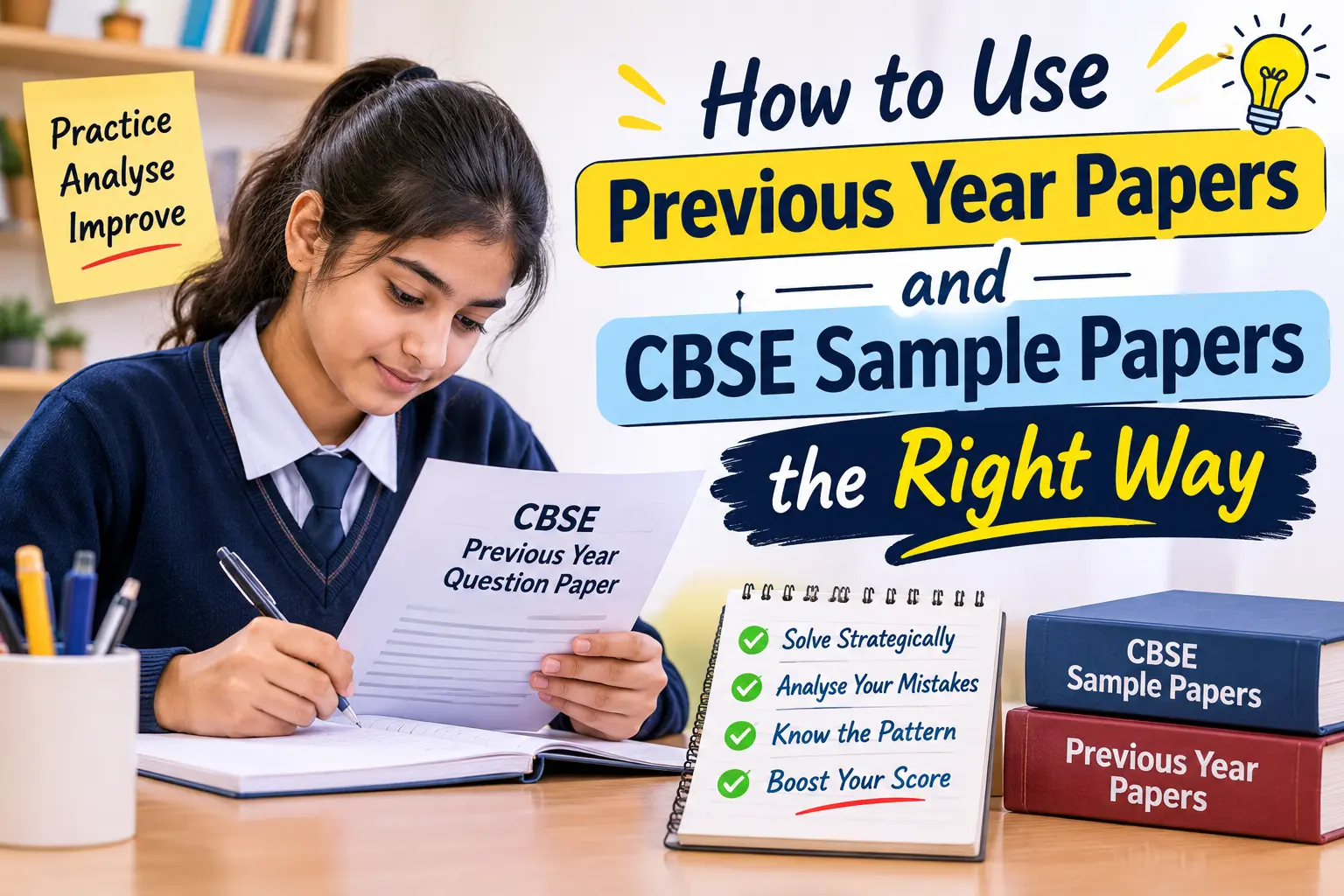
CBSE’s sample papers and marking schemes for 2026-27 are already out, for both Class 10 and Class 12. Each paper notes that there is no change in the question paper design and assessment pattern for this session. That makes the official sample papers the single most useful practice material you have.
A month-by-month study plan for board exams
This is how to prepare for board exams from November onwards if your theory papers start in mid-February. Adjust the dates if your board or school schedule is different.
| Month | Main goal | What to do each week |
|---|---|---|
| November | Finish the remaining syllabus | Cover the chapters your school hasn’t finished. After each chapter, answer the NCERT exercise questions without looking. Start a mistakes notebook. Try one section of a sample paper in each subject. |
| December | Complete the syllabus and revise once | Aim to finish every chapter by mid-December. Then go through each chapter once more, testing yourself as you go. Many schools hold their first pre-board exam in December or early January. |
| January | Full papers, practicals, second revision | Solve two or three full sample papers a week under timed conditions. Finish practical files and projects. Spend your revision time on the chapters where you lost the most marks. |
| February | Final revision and routine | Go over formulas, diagrams, maps, definitions and your mistakes notebook. Solve a paper every two or three days at the same time of day as the real exam. Keep your sleep regular. |
| During the exams | Use the gaps well | Use the days between papers for the next subject only. Do one timed paper, revise your notes and sleep early the night before. |
What a normal study day can look like
On a school day, two to four hours of focused study after school is realistic for most students, split into blocks of about 45 minutes with short breaks. On holidays and weekends, you can do more, but six or seven hours of real work beats ten hours of half-attention. A simple rule helps: one hard subject and one easier subject each day, so you never dread sitting down.
If you’re starting late
If you have only six to eight weeks, don’t panic and don’t try to read everything. Download the syllabus for each subject, which shows how many marks each unit carries, and start with the units worth the most. Solve the official sample paper for each subject first, so you know the question types, and then study chapter by chapter with the paper in mind. Your CBSE board exam 2027 preparation can still go well with a late start, as long as you practise answering questions rather than only reading.
Study methods that actually work
Most advice on how to prepare for board exams focuses on hours. Research suggests the method matters at least as much. A well-known review led by psychologist John Dunlosky looked at ten study techniques students commonly use. Two came out on top: practice testing and distributed practice (spreading study out over time). Highlighting, rereading and summarising were rated low, even though they are among the most popular. As Dunlosky put it in the Association for Psychological Science’s summary of the review, “By just replacing rereading with delayed retrieval practice, students would benefit.”
Test yourself (active recall)
After studying a topic, close the book and try to write down the key points, draw the diagram or solve a question from memory. Then check what you missed. It feels harder than rereading, and that is exactly why it works. Flashcards, the questions at the end of NCERT chapters and explaining a topic aloud to a friend are all forms of self-testing.
Space out your revision
Instead of revising a chapter once for three hours, revise it for an hour on three different days. A simple revision plan is to go back to a chapter a day after you study it, again a week later, and again two or three weeks after that. Each time, start by testing yourself before you look at your notes.
Mix topics when you practise
In Maths and Science especially, solving a mixed set of problems from different chapters is better preparation than doing twenty questions of the same type. The board paper won’t tell you which chapter a question comes from, so practise working that out yourself.
Keep a mistakes notebook
Every time you get something wrong in a test, a sample paper or a pre-board, write it down: the question, what you did wrong and the correct method. Read this notebook every week. By February it will be the most valuable revision material you have, because it’s built from your own weak spots.
Subject-wise board exam preparation tips
The general methods above apply to every subject, but each subject also has its own habits that win marks.
Mathematics
- Practise every day, even if it’s only for 30 minutes. Maths skills fade quickly without practice.
- Keep a single sheet of formulas and theorems for each chapter and test yourself on it.
- Write every step. Marking schemes give marks for steps, so a correct method can earn marks even if the final answer is wrong.
- Practise case-based and competency-based questions from the sample paper, not just textbook exercises.
Science
- Read the NCERT textbook carefully, including in-text questions, activities and the summary at the end of each chapter.
- Practise diagrams until you can draw and label them neatly from memory.
- Write balanced chemical equations and include units in every numerical answer.
Social Science
- Practise map work every week. These are some of the easiest marks in the paper.
- Make simple timelines for history and comparison tables for geography and economics.
- Write longer answers in points with a short introduction, and use the keywords from the textbook.
English and other languages
- Learn the formats for letters, notices, articles and other writing tasks, and practise one piece a week.
- Revise grammar through short daily exercises rather than long sessions.
- For literature, know each chapter’s theme, characters and key events, and practise answering in your own words.
Class 12 subjects
- Science stream: learn derivations and practise numericals in Physics, revise reactions and named reactions from NCERT in Chemistry, and practise diagrams and exact terms in Biology.
- Commerce stream: practise Accountancy formats and adjustments regularly, and draw diagrams in Economics wherever they fit.
- Humanities: practise long answers against the clock, with clear structure and examples.
- Entrance exams: if you’re also preparing for JEE, NEET or CUET, use NCERT as your common base and keep the last six to eight weeks before boards mainly for board-style answer writing.
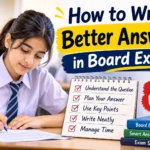
How to write answers that score
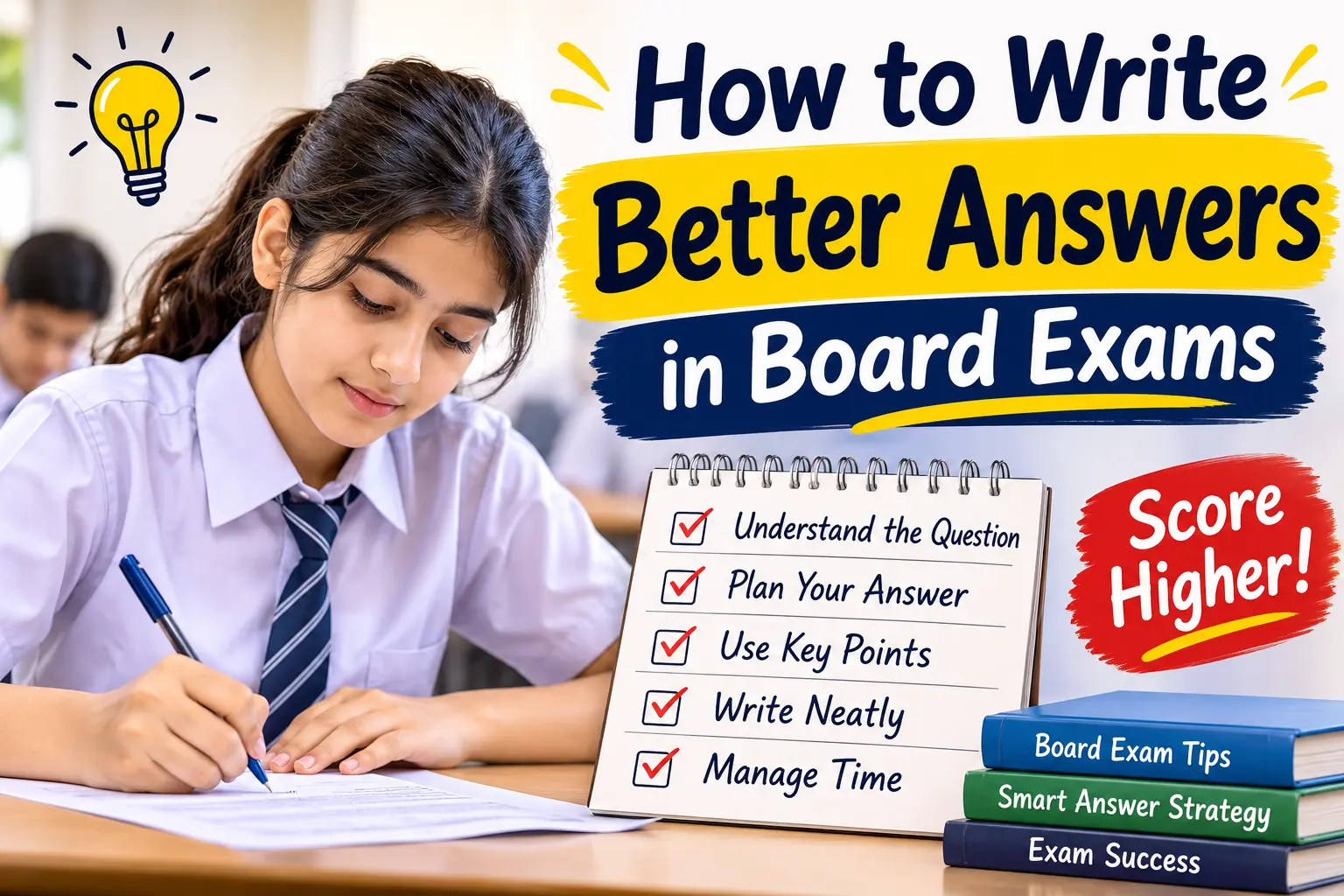
Many students lose marks not because they don’t know the answer but because of how they write it. A few habits make a big difference:
- Study the marking scheme. Solve a sample paper, then compare your answers with the official marking scheme. You’ll see exactly which points, steps and keywords earn marks.
- Match length to marks. A one-mark answer needs a word or a line. A five-mark answer needs a structured explanation with several clear points.
- Plan before you write. Use the reading time at the start to choose your internal choices and decide which section to begin with.
- Manage your time. Decide roughly how long each section should take, and leave ten minutes at the end to check your paper.
- Don’t leave questions blank. Write what you know. A partly correct answer can still earn marks.
- Keep it neat. Clear handwriting, labelled diagrams and well-spaced answers make an examiner’s job easier.
Look after yourself while you prepare
Sleep is part of how to prepare for board exams, not a break from it. Your brain needs rest to learn, and cutting sleep to study more usually backfires, because memory and attention both suffer. The American Academy of Sleep Medicine recommends that teenagers aged 13 to 18 sleep 8 to 10 hours every 24 hours on a regular basis. Late-night cramming before a paper is one of the most common mistakes students make.
- Keep a fixed time to sleep and wake up, even on weekends.
- Take a short break every 45 to 50 minutes. Stand up, walk around or get some fresh air.
- Move every day. A walk, a game or some stretching helps you focus better afterwards.
- Eat regular meals and drink enough water. Skipping meals makes it harder to concentrate.
- Keep your phone in another room during study blocks, or switch off notifications.
Feeling some pressure before board exams is normal. If worry is affecting your sleep, appetite or mood for days at a time, talk to a parent, teacher or school counsellor. You can also call Tele-MANAS, the government’s free mental health helpline, on 14416 at any time of day.
How parents can help
Parents often ask how to prepare for board exams as a family without making things more stressful. The most useful support is usually practical and quiet:
- Protect the routine. Help keep meals, sleep and study times regular, and keep the house calm during study hours.
- Give them a study space. A quiet corner with a table, good light and no TV nearby is enough.
- Ask about the plan, not the marks. “What are you working on this week?” helps far more than “How much did you score?”
- Don’t compare. Comparing your child with cousins, friends or older siblings adds pressure and rarely motivates.
- Handle the logistics. Admit cards, stationery, transport and exam-centre timings are things you can take off their mind.
- Watch for signs of stress. Changes in sleep, appetite or mood that last more than a few days are worth a gentle conversation.
Common mistakes to avoid
- Using too many books. NCERT plus the official sample papers and one good question bank is enough for most students.
- Only studying favourite subjects. Weak subjects need more time, not less.
- Never timing practice papers. Knowing the answers is not the same as finishing the paper in three hours.
- Ignoring practicals and internal assessment. These marks count, and they are among the easiest to secure.
- Counting on the May exam. For Class 10, the second exam only lets you improve up to three subjects, and it covers the full syllabus again.
- Staying up late before a paper. A good night’s sleep is worth more than a few extra hours of revision.
After Class 10: planning for Class 11
Once your last paper is over, the next decision comes quickly: which stream to take in Class 11, and sometimes which school. Some students change schools at this point because their current school doesn’t offer the stream or subject combination they want. Under CBSE’s two-exam system, students who don’t clear the first exam can take provisional admission to Class 11, which is confirmed after the second exam result.
If you’re thinking about a change, it helps to shortlist schools before results come out, since many schools fill Class 11 seats soon after. You can compare CBSE schools for Class 11 by city, fees and facilities in one place.
Frequently asked questions
How many hours should I study a day for board exams?
There’s no magic number. Two to four focused hours on school days and six to seven on holidays works for most students. What you do in those hours matters more than how long you sit at your desk, so spend most of the time testing yourself and solving questions.
Is three months enough to prepare for board exams?
Yes, for most students, if the syllabus has mostly been taught in school. Use the first month to finish and revise the syllabus, the second for full sample papers and weak areas, and the third for final revision.
Is NCERT enough for CBSE board exams?
NCERT textbooks are the foundation of CBSE papers, and most questions are based on them. Add the official sample papers and marking schemes for practice. Extra reference books are useful only once you know NCERT well.
How can I score above 90% in board exams?
High scorers usually do three things well: they know NCERT thoroughly, they solve many full papers under timed conditions, and they write answers the way the marking scheme expects. Consistency from November onwards matters more than last-minute effort.
When will the CBSE 2027 date sheet be released?
CBSE hadn’t released it at the start of November 2026. In earlier years, the final date sheet has usually come out between late October and December. Check cbse.gov.in for the official notice and ignore unofficial timetables shared on social media.
How many board exams will Class 10 students take in 2027?
CBSE Class 10 students will have a compulsory main exam in February and March and an optional second exam in May to improve up to three subjects. ICSE and ISC students have one main exam in February and March. Check the CISCE website for its rules on improvement exams.
Is it better to study at night or early in the morning?
Either can work, as long as you get enough sleep. Since board papers are held in the daytime, it helps to shift your study routine towards the morning in the last few weeks so your brain is alert at exam time.
How do I prepare for board exams and JEE or NEET together?
Use NCERT as the common base for both, since much of the board syllabus overlaps with entrance exam topics. From January, give boards priority and practise board-style written answers, then switch back to entrance practice after your last paper.
How we put this guide together
We wrote this guide to show students how to prepare for board exams with a plan they can actually follow. It draws on CBSE’s official notifications, sample papers and marking schemes, CISCE’s published timelines, reported results from the first two-exam year, published research on study techniques and sleep guidance for teenagers. Board schedules change every year, so always check your board’s official website for the latest dates. Last updated: November 2026.
9 thoughts on “How to Prepare for Board Exams 2027: A Complete Study Plan”