









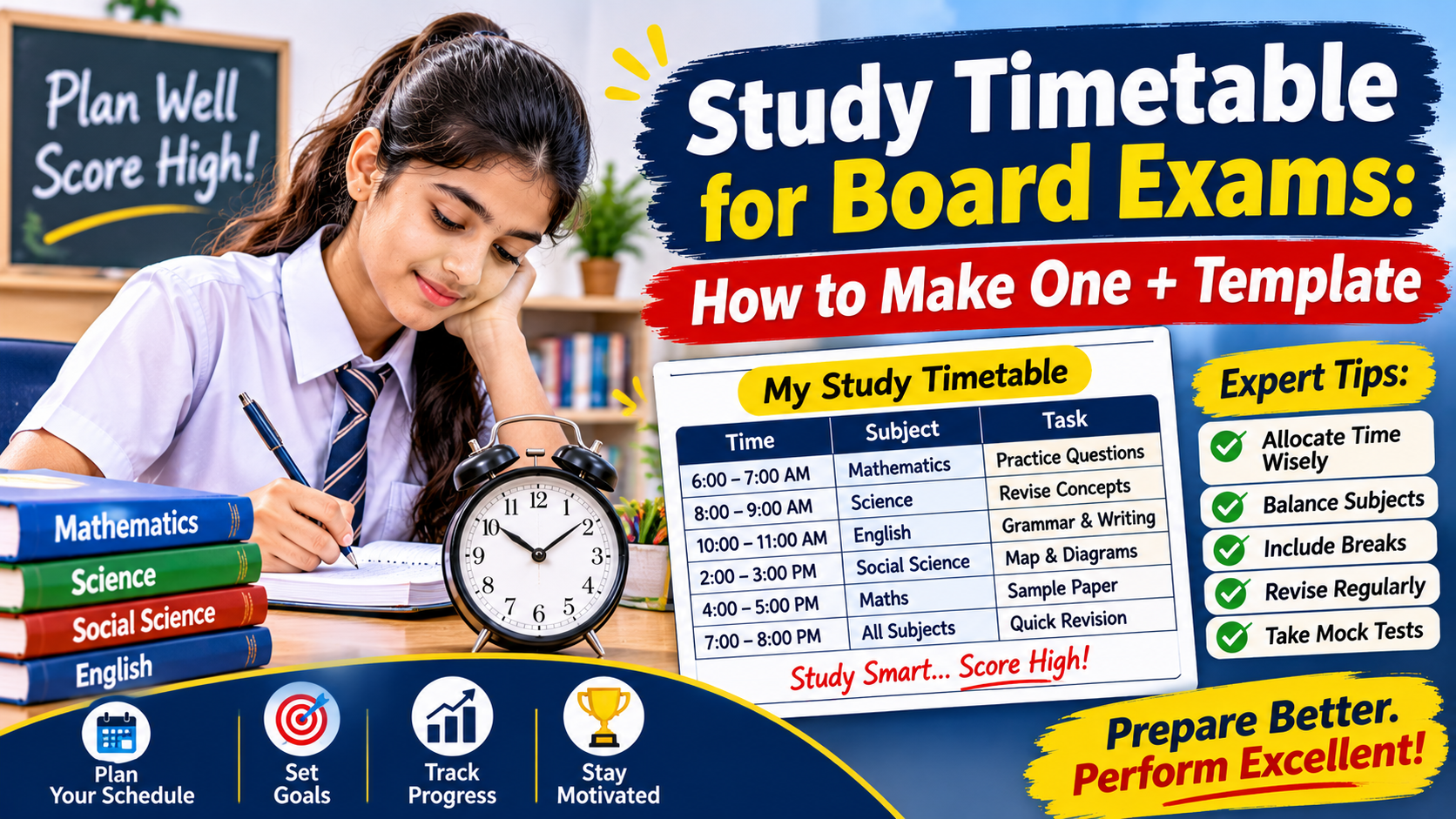
A good study timetable for board exams isn’t the one with the most hours. It’s the one you can actually follow on a normal school day, with tuition, meals and enough sleep built in. Many timetables shared online start at 5 am and end after midnight. Almost nobody sticks to those for more than a few days.
This guide shows you how to make a timetable that fits your real day, with three ready-made examples: a school day, a holiday or weekend, and a pre-board week. There’s also a free printable template you can download and fill in. If you haven’t planned your months yet, start with our board exam study plan, then use this guide to plan each day.
How to make a study timetable for board exams in 7 steps
Here’s how to make a timetable that works, step by step. It takes about 30 minutes the first time.
- Block out the fixed hours first. Write down school, travel, tuition, meals and sleep. Teenagers aged 13 to 18 need 8 to 10 hours of sleep a night, according to the American Academy of Sleep Medicine, so put sleep in before anything else.
- Find your free blocks. Look at what’s left and split it into study blocks of 45 to 50 minutes, with 10-minute breaks between them.
- Rate your subjects. Mark each one as strong, average or weak. Weak subjects get more blocks each week.
- Pair hard with easier subjects. Put one demanding subject, such as Maths or Physics, and one lighter subject, such as a language, on the same day. Do the hard one when you’re freshest.
- Add revision blocks. Keep at least one block a day for revising something you studied a few days or a week earlier. Spacing out revision helps you remember more.
- Add one timed paper a week. From December, give one weekend morning to a full sample paper under exam conditions.
- Review it every Sunday. Check what you finished, move what you didn’t, and plan the next week.
Timetable 1: a school day
Most of your weeks will run on a school-day study timetable for board exams like this one. This daily routine for board exam students assumes school until about 2:30 pm and tuition in the early evening. Move the blocks to match your own timings.
| Time | What to do |
|---|---|
| 6:30 am | Wake up, get ready, breakfast |
| 7:30 am – 2:30 pm | School |
| 2:30 – 3:30 pm | Lunch and rest. Don’t start studying straight away. |
| 3:30 – 4:20 pm | Block 1: a hard subject (Maths or Science) |
| 4:30 – 6:00 pm | Tuition, or Block 2 if you don’t have tuition today |
| 6:00 – 6:45 pm | Outdoor time, exercise or a walk, and a snack |
| 6:45 – 7:35 pm | Block 2: Social Science or a language |
| 7:35 – 8:30 pm | Dinner and family time |
| 8:30 – 9:15 pm | Block 3: test yourself on an older chapter, then read your mistakes notebook |
| 9:15 – 9:45 pm | Pack your bag, no screens, wind down |
| 9:45 – 10:00 pm | Sleep |
That’s about two and a half hours of focused self-study plus tuition, and eight and a half hours of sleep. For most students, that’s a realistic school-day load.
Timetable 2: a holiday or weekend
On free days you can do more, but keep the same wake-up and sleep times so your body clock doesn’t shift. This weekend study timetable gives you about five and a half hours of real study.
| Time | What to do |
|---|---|
| 7:00 – 8:00 am | Wake up, freshen up, breakfast |
| 8:00 – 8:50 am | Block 1: your weakest subject |
| 9:05 – 9:55 am | Block 2: practice questions in the same subject |
| 10:15 – 11:05 am | Block 3: Social Science |
| 11:20 am – 12:10 pm | Block 4: a language (writing task or grammar) |
| 12:10 – 2:00 pm | Lunch, rest and free time |
| 2:00 – 2:50 pm | Block 5: Science or Maths |
| 3:05 – 3:50 pm | Block 6: revision by self-testing |
| 4:00 – 6:00 pm | Sport, hobbies, friends or family |
| 6:00 – 6:50 pm | Block 7: mistakes notebook and planning for the week |
| 7:00 – 10:00 pm | Dinner, family time, light reading, then sleep by 10 |
Mock paper day: once a week from December, replace Blocks 1 to 4 with a full sample paper from 10:30 am to 1:30 pm, the usual CBSE exam timing. Spend Block 5 checking it against the marking scheme.
Timetable 3: a pre-board or exam week
When you have a paper every day or two, your timetable changes. The aim is to stay calm and fresh, not to cram.
| Time | What to do |
|---|---|
| 6:45 am | Wake up, breakfast |
| 7:30 – 8:15 am | Light revision for today’s paper: formulas, key points, diagrams |
| 9:15 am | Leave for school or the exam centre with plenty of time |
| 10:30 am – 1:30 pm | Exam |
| 1:30 – 3:00 pm | Lunch and rest. Skip the long discussion of answers. |
| 3:00 – 3:50 pm | Block 1: next subject, hardest chapters first |
| 4:05 – 4:55 pm | Block 2: next subject, practice questions |
| 5:00 – 6:00 pm | Walk or exercise |
| 6:00 – 6:50 pm | Block 3: test yourself on the whole next paper |
| 7:00 – 8:00 pm | Dinner |
| 8:00 – 8:45 pm | Formula sheet and mistakes notebook only |
| 9:30 pm | Sleep |
Free template: a study timetable for board exams you can print
Our printable template has two pages. The first is a weekly planner with space for seven days and up to seven study blocks a day, plus your goals for the week. The second is a chapter tracker for one subject, where you tick off each chapter as you finish it and revise it a first, second and third time.
Download the free study timetable template (PDF)
Print one weekly page for each week and one tracker page for each subject. Fill in the week in pencil on Sunday evening, and pin it somewhere you’ll see it every day.
Timetables for Class 10 and Class 12
A time table for Class 10 students can follow the examples above almost exactly. Rotate Maths, Science, Social Science, English and your second language through the week, and don’t forget your skill subject. If you want week-by-week dates from November to February, use our 100-day plan to decide what goes in each week.
A study schedule for Class 12 needs room for entrance exam preparation too. If you’re preparing for JEE, NEET or CUET, use NCERT as the common base and give boards extra blocks from January. In the last six to eight weeks before boards, most of your blocks should be board-style written practice.
Common timetable mistakes
Most problems with a study timetable for board exams come from a handful of common mistakes:
- Planning too many hours. A 12-hour plan you abandon on day three is worse than a 3-hour plan you follow for months.
- Cutting sleep. Waking at 5 am after studying till 1 am leaves you tired and forgetful.
- One subject all day. Rotating subjects keeps you fresh and helps you remember more.
- No revision blocks. If you only study new chapters, you’ll forget the old ones by February.
- No spare time. Leave one or two empty blocks a week to catch up when things slip.
- Copying a topper’s routine. Their school hours, tuition and sleep needs aren’t yours. Build your own.
Frequently asked questions
How many hours should a study timetable for board exams include?
Around two to three focused hours on school days and five to six on holidays works for most students. What you do in that time matters more than the number of hours.
What is the best time to study for board exams?
Whenever you’re most alert, as long as you still get 8 to 10 hours of sleep. In the last few weeks, shift your hardest study towards the morning, because board papers are held in the morning.
Should I include tuition in my study timetable?
Yes. Count tuition as a fixed block, but don’t count it as self-study. You still need time on your own to practise and revise what was taught.
How often should I change my timetable?
Review it every week and make small changes. Make bigger changes when your phase changes, for example when you finish the syllabus and move to full papers and revision.
What if I can’t follow my timetable?
That usually means it’s too full. Cut it back to what you can manage on a normal day, then add more once you’ve followed it for a week.
How we put this guide together
We built these examples of a study timetable for board exams around typical Indian school and tuition hours, with sleep protected first, using sleep guidance for teenagers from the American Academy of Sleep Medicine and the usual CBSE exam timings. Adjust the times to your own school, board and routine. Last updated: November 2026.

One thought on “Study Timetable for Board Exams: How to Make One + Template”