







How to prepare for ICSE Class 10 board exam 2027, in short: finish your textbooks and internal assessment work by December, practise CISCE specimen papers and past papers under a timer from January, and plan your revision around the timetable, which runs from 15 February to 31 March 2027. ICSE papers are long and detailed, so writing practice matters as much as reading.
This guide covers the 2027 timetable, how ICSE marks work, a month-by-month plan, subject-wise tips and what to do on exam days. It’s written for ICSE students, and it sits alongside our general board exam study plan.
ICSE 2027: key dates
CISCE has released the 2027 timetable. ICSE Class 10 exams run from 15 February to 31 March 2027, according to Careers360’s report on the CISCE timetable. News reports of the timetable list these main papers:
| Date | Paper
|
|---|---|
| 15 February 2027 | English Paper 1 (English Language) |
| 18 February 2027 | English Paper 2 (Literature in English) |
| 22 February 2027 | Mathematics |
| 26 February 2027 | History and Civics (H.C.G. Paper 1) |
| 1 March 2027 | Geography (H.C.G. Paper 2) |
Reading time starts at 10:00 am and writing at 10:15 am, so be seated by 9:45 am. Check the official timetable on cisce.org for your own subjects, especially Science, languages and Group III papers, and note the gaps between them.
How ICSE marks work
ICSE subjects are in three groups. In Group I (English, a second language, and History, Civics and Geography) and Group II (such as Mathematics, Science, Economics and Commercial Studies), each subject has 80 marks for the board paper and 20 for internal assessment. Group III subjects, such as Computer Applications and Art, are split 50 for the paper and 50 for internal assessment, as set out in this summary of the ICSE marking scheme.
That has two practical effects:
- Internal assessment is worth real marks. Projects, practical files and Group III coursework need to be finished well and on time, usually before the board exams begin.
- Group III is half coursework. A strong project in Computer Applications or Art can make a big difference to your overall marks.
So any plan for how to prepare for ICSE Class 10 board exam should start with your internal assessment deadlines. Ask each subject teacher for them now.
How to prepare for ICSE Class 10 board exam: a month-by-month plan
| When | Main goal | What to do
|
|---|---|---|
| Late Nov – Dec | Finish and submit | Finish any chapters left, complete projects and practical files, and revise each chapter once by testing yourself. |
| Early Jan | First full papers | One specimen paper per main subject under a timer, then mark it. List your three weakest topics in each subject. |
| Jan – early Feb | Past papers and pre-boards | Two or three full papers a week. Rework every mistake. Revise literature texts and History dates twice a week. |
| Feb – Mar | Between papers | Use the gaps in the timetable: revise the next subject, solve one paper in it, and sleep on time. |
ICSE has a long exam season, about six weeks, so plan your energy. Don’t burn out before the later papers. Our guide on how to use previous year question papers explains how to get the most from past papers, and a study timetable for board exams helps you plan each day.
How to prepare for ICSE Class 10 board exam if you’re starting late
If you’re reading this in January with a lot left to do, don’t panic. Six weeks of focused work can still change your result.
- List what’s left in every subject and finish internal assessment work first, because those marks are already within reach.
- Use the timetable gaps. ICSE papers are spread over six weeks, so subjects later in March give you extra time.
- Prioritise English, Mathematics and your strongest Group II subject, then revise the others by topic.
- Solve at least one full paper per subject before its exam, under time.
- Sleep and eat normally. Cramming through the night hurts more than it helps over a long exam season.
Subject-wise tips
English Language and Literature
- Practise compositions, letters and comprehension under time; ICSE English rewards clear, accurate writing.
- Know your prescribed texts well: characters, themes and key incidents, with short references to the text.
- Keep a list of grammar errors you make often and check for them in every answer.
Mathematics
- Show every step and keep working neat; method carries marks.
- Practise each chapter’s standard question types from your textbook and past papers.
- Keep a formula sheet and revise it daily from January.
Physics, Chemistry and Biology
- Learn definitions and laws word for word, and practise labelled diagrams.
- In Chemistry, practise balanced equations and observations for tests.
- In Physics, write the formula, substitute with units, then give the answer.
History, Civics and Geography
- Learn History and Civics in points with dates and key terms.
- Practise map work and topographical sheet questions regularly for Geography.
- Answer exactly what’s asked; long, unfocused answers lose time.
Group III subjects
- Finish the project or practical work early and check it against your teacher’s guidelines.
- For Computer Applications, practise writing programs by hand, not only on a computer.
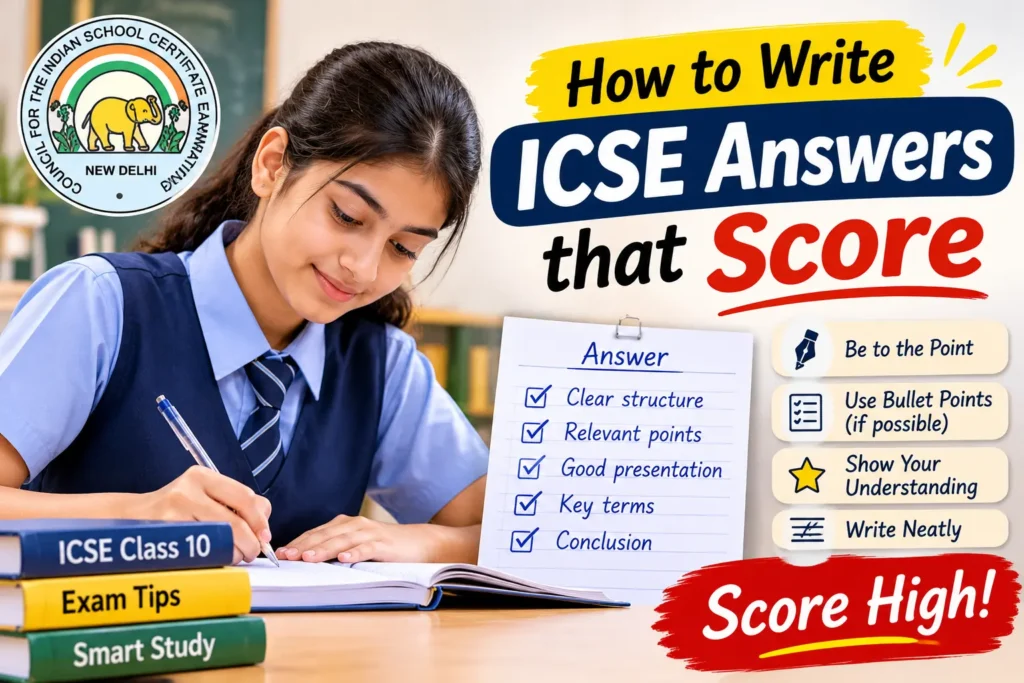
- Use the 15 minutes of reading time to choose your questions and plan the order.
- Write the question number clearly and answer all parts of a question together.
- Match the length to the marks, and use the keywords from your textbook.
- Keep the last 10 to 15 minutes for checking.
For more on answer technique, see our guide on how to write answers in board exam papers. Most of it applies to ICSE too.
Common mistakes ICSE students make
- Leaving project and practical work until the last minute.
- Reading literature summaries instead of the actual texts.
- Skipping map and diagram practice.
- Studying only from guidebooks and never solving a full paper under time.
- Peaking too early and running out of energy for the March papers.
Choosing an ICSE school for Class 11?
If you’re thinking about changing school after Class 10, now is a good time to look. You can compare ICSE schools in Dehradun or ICSE and ISC schools across India, including those that admit students in Class 11.
Frequently asked questions
How to prepare for ICSE Class 10 board exam in 3 months?
Finish the syllabus and internal work in the first month, then spend the next two on specimen papers, past papers and revision of weak topics. Practise full papers under time at least twice a week from January.
When do the ICSE 2027 exams start?
ICSE Class 10 exams start on 15 February 2027 with English Paper 1 and end on 31 March 2027. Check cisce.org for the subject-wise timetable.
How are ICSE marks divided?
Group I and Group II subjects have 80 marks for the board paper and 20 for internal assessment. Group III subjects are usually 50 for the paper and 50 for internal assessment.
Are ICSE specimen papers useful?
Yes. CISCE’s specimen papers show the current pattern and type of questions. Solve them under exam conditions first, then move on to past papers.
Is ICSE harder than CBSE?
ICSE has a broader syllabus and longer, more detailed answers, especially in English and the humanities. Many students find it demanding but manageable with steady writing practice.
How we put this guide together
To explain how to prepare for ICSE Class 10 board exam 2027, we used CISCE’s 2027 timetable as reported in the news, the ICSE marking scheme for Groups I, II and III, and the question types in CISCE specimen papers. Always check cisce.org and your school for the latest instructions. Last updated: November 2026.