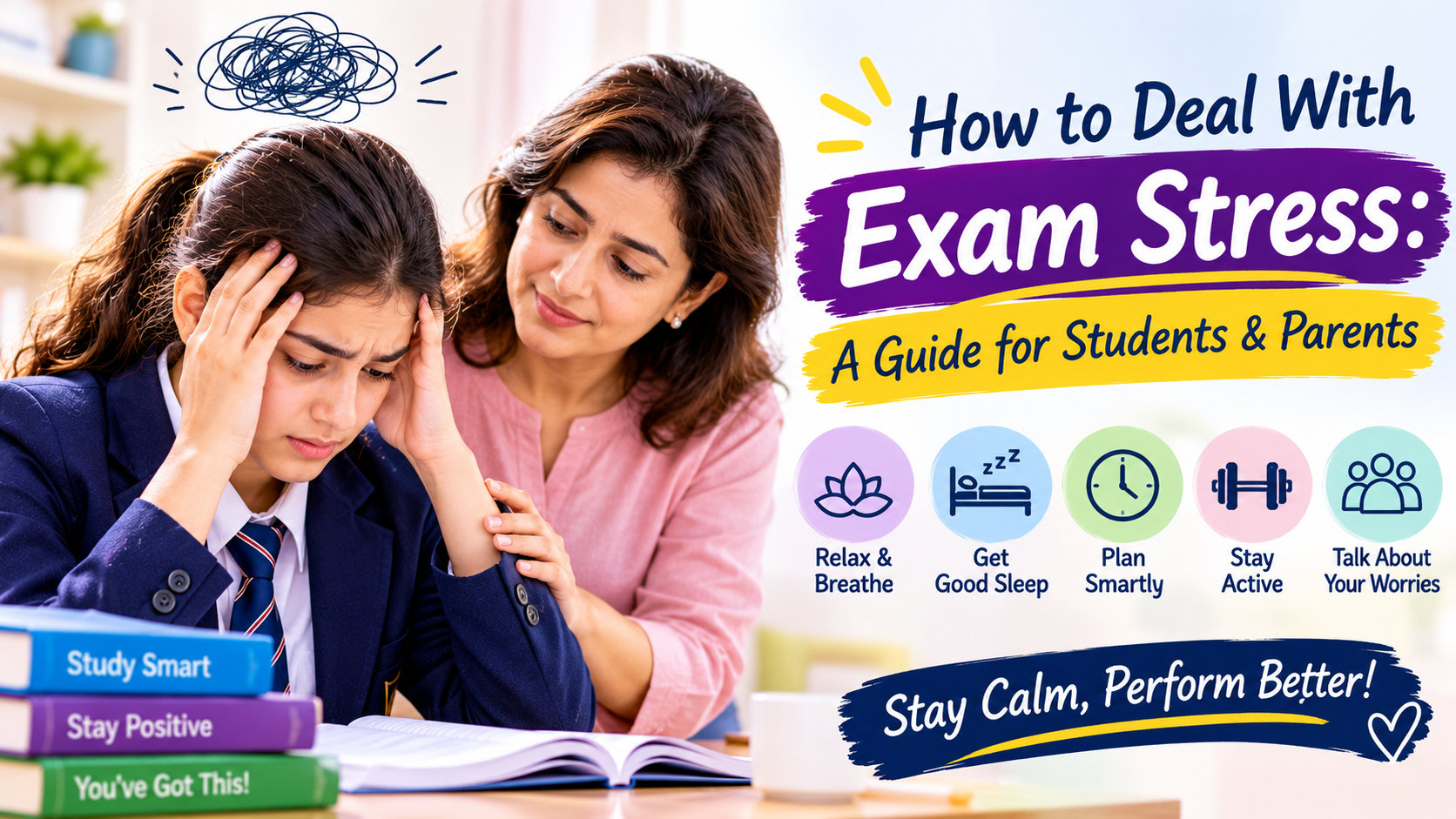










Wondering how parents can help their child during exams without adding pressure? The short answer: keep home calm and predictable, look after the basics (sleep, food, a quiet place to study), and talk about effort and plans rather than marks. Most of what helps is small and practical, and most of what hurts is said with good intentions.
This guide is for parents of children in Classes 9 to 12, especially those facing board exams in February and March 2027. It covers what to do, what to say and what to avoid, and how to tell normal exam stress from something that needs more help. For the student’s side of the story, our guide to exam stress is a good companion read.
Why your role matters so much
Exams are stressful for most teenagers, and Indian students are no exception. In one study of Indian high school students, cited in a 2019 paper on academic stress, nearly two-thirds (63.5%) reported stress due to academic pressure. NCERT’s mental health and well-being survey found that students at the secondary stage reported more anxiety about studies, exams and results than younger students, as reported by Careers360.
Some of that pressure comes from home, often without parents meaning it to. The good news is that home is also where you can do the most to support your child during exams, and almost none of it needs special skills or money.
How parents can help their child during exams: 12 things that work
1. Keep the daily routine steady
Regular meals, a fixed wake-up time and a fixed bedtime make study easier to plan. Avoid big changes, late-night functions or travel in the weeks before boards where you can.
2. Protect sleep
Teenagers need 8 to 10 hours of sleep. Late-night cramming feels productive but makes the next day slower. If your child is studying past midnight regularly, help them move study earlier rather than praising the late nights.
3. Give them a study corner
A table, a chair, good light and no TV nearby is enough. In a small home, agree on “quiet hours” when the TV stays off. A calm study environment at home matters more than an expensive desk.
4. Ask about the plan, not the marks
“What are you working on this week?” helps far more than “How much will you score?” If your child doesn’t have a plan yet, help them make one using a simple study timetable for board exams.
5. Listen first
When your child says they’re worried, resist the urge to fix it straight away. Let them finish. Saying “That sounds hard. What would help?” often does more than advice.
6. Don’t compare
Comparisons with cousins, neighbours’ children or older siblings rarely motivate. They usually make a child feel that nothing they do is enough.
7. Handle the relatives
Questions like “How are the boards going?” from every visitor add pressure. It’s fine to say, on your child’s behalf, “We’re not discussing marks till March.”
8. Agree on phone rules together
Taking the phone away completely often backfires. Agree on a few rules instead, such as the phone outside the room during study blocks, and set a time when it’s free to use.
9. Take care of the logistics
Keep a copy of the date sheet on the fridge, check the admit card details early, and know the route and reporting time for the exam center. One less thing for your child to think about.
10. Feed them well, and simply
Regular home meals, water and fruit are enough. Exam day isn’t the time for a new or heavy dish.
11. Build in breaks together
A 20-minute evening walk, a meal without talk of studies, or a short game helps your child reset. It also keeps the relationship warm through a tense few months.
12. Look after your own stress
Children pick up on their parents’ worry quickly. Talk to your partner or a friend about your own anxiety, not to your child. UNICEF India’s advice on dealing with exam anxiety asks parents to stay present, listen with empathy and build their child’s confidence.
What to say, and what not to say
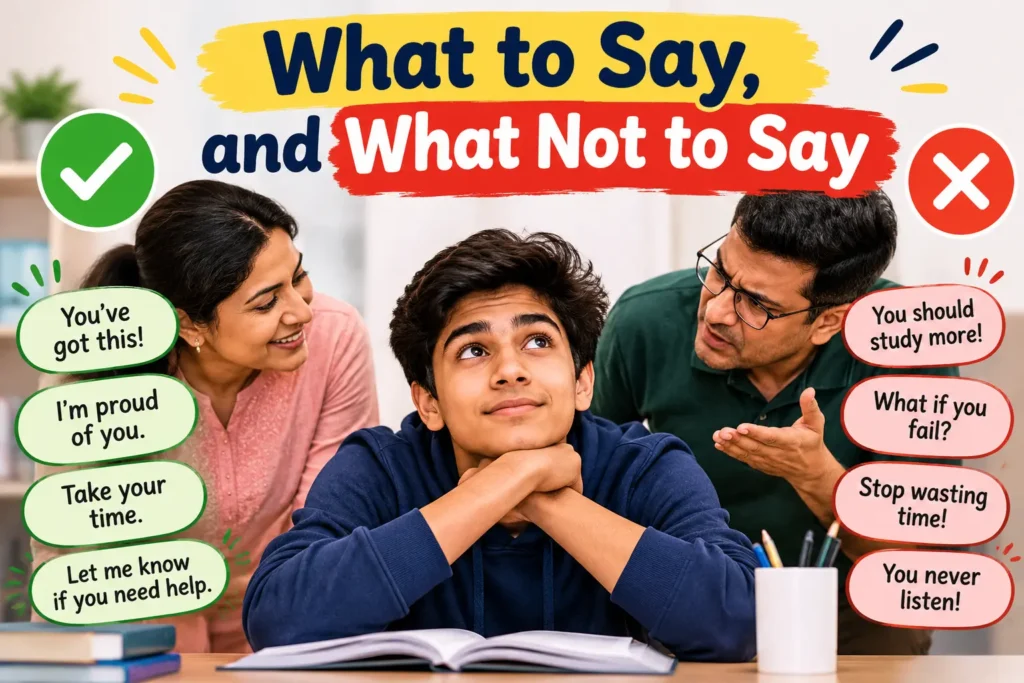
A big part of how parents can help their child during exams comes down to everyday words. Here’s what not to say before exams, and what to say instead.
| Instead of… | Try…
|
|---|---|
| “You have to score 95%.” | “Do your best. We’re proud of the effort you’re putting in.” |
| “Sharma ji’s son studies 10 hours a day.” | “What’s working for you this week, and what isn’t?” |
| “Why are you on your phone again?” | “Shall we agree on when the phone is off during study time?” |
| “If you fail, what will people say?” | “Whatever happens, we’ll figure out the next step together.” |
| “How did the paper go? What did you get wrong?” | “Done with that one! Eat, rest, and then think about the next paper.” |
On exam days
On the days of the papers themselves, this is how parents can help their child during exams without any fuss.
- The night before: a normal dinner, a short revision of key points, and sleep at the usual time. Pack the admit card, pens, water bottle and anything the school allows the night before.
- In the morning: a light breakfast, and leave early enough that no one is rushing. Keep conversation light.
- After the paper: don’t go through every answer. A short “How do you feel?” is enough. Then help your child move on to the next paper.
If pre-board marks are low
Pre-boards are often set harder than the real exam, and many students score lower than they expect. Treat the result as a map, not a verdict. Sit with your child, look at where the marks were lost, and help them pick the three chapters to fix first. Our board exam study plan shows how the last weeks can be used for exactly this.
Result day
Plan result day in advance. Be at home, check the result together, and decide beforehand that your first words will be about your child, not the number. If the result is disappointing, there are always next steps, including re-evaluation, a second attempt where your board allows it, and different stream or school options.
When your child may need more help
Some stress before exams is normal. It’s worth getting help if, for two weeks or more, your child:
- sleeps or eats much less, or much more, than usual
- has frequent headaches, stomach aches or panic before tests
- withdraws from family and friends, or stops doing things they usually enjoy
- seems hopeless, or can’t study at all despite trying
Start by talking to your child calmly, then to the class teacher or school counsellor. CBSE runs free psycho-social counselling for Class 10 and 12 students each board season on its toll-free number 1800-11-8004; in 2026 it ran from January to June, according to All India Radio News. Check cbse.gov.in for the 2027 dates.
If your child ever talks about not wanting to live or about harming themselves, get help the same day: call Tele-MANAS on 14416, see a doctor, or call 112 if there is immediate danger.
Frequently asked questions
How can parents help their child during exams without putting pressure?
Keep routines steady, protect sleep and meals, and talk about effort and plans rather than marks. That’s the core of how parents can help their child during exams. Avoid comparisons, handle questions from relatives yourself, and make it clear your support doesn’t depend on the result.
What should parents not say before an exam?
Avoid comparisons, threats about results, and questions about how many marks they’ll get. On exam day, skip last-minute advice and long discussions of answers after the paper. A calm “All the best, we’re proud of you” is enough.
Should parents sit with their child while they study?
Only if your child wants that. Many teenagers study better alone. Being nearby and available, rather than watching over them, usually works better, especially in Classes 10 and 12.
Should I take away my child’s phone during board exams?
A complete ban often leads to arguments. Agree on rules together instead: the phone outside the room during study blocks, notifications off, and a set time each evening when it’s free to use.
How do I know if my child’s exam stress is serious?
Watch for changes that last two weeks or more: poor sleep or eating, frequent physical complaints, withdrawal, or hopelessness. Talk to the school counsellor or a doctor, and call Tele-MANAS on 14416 for free support at any time.
About this guide
This guide explains how parents can help their child during exams in general terms. It isn’t medical advice. We drew on UNICEF India’s exam anxiety advice, research on academic stress among Indian students, NCERT’s student well-being survey, CBSE’s counselling service, and common questions from Indian parents. Last updated: November 2026.
Free support in India: Tele-MANAS, the government’s mental health helpline, is free and available 24×7 on 14416 or 1-800-891-4416. More details are on the Tele-MANAS website.