








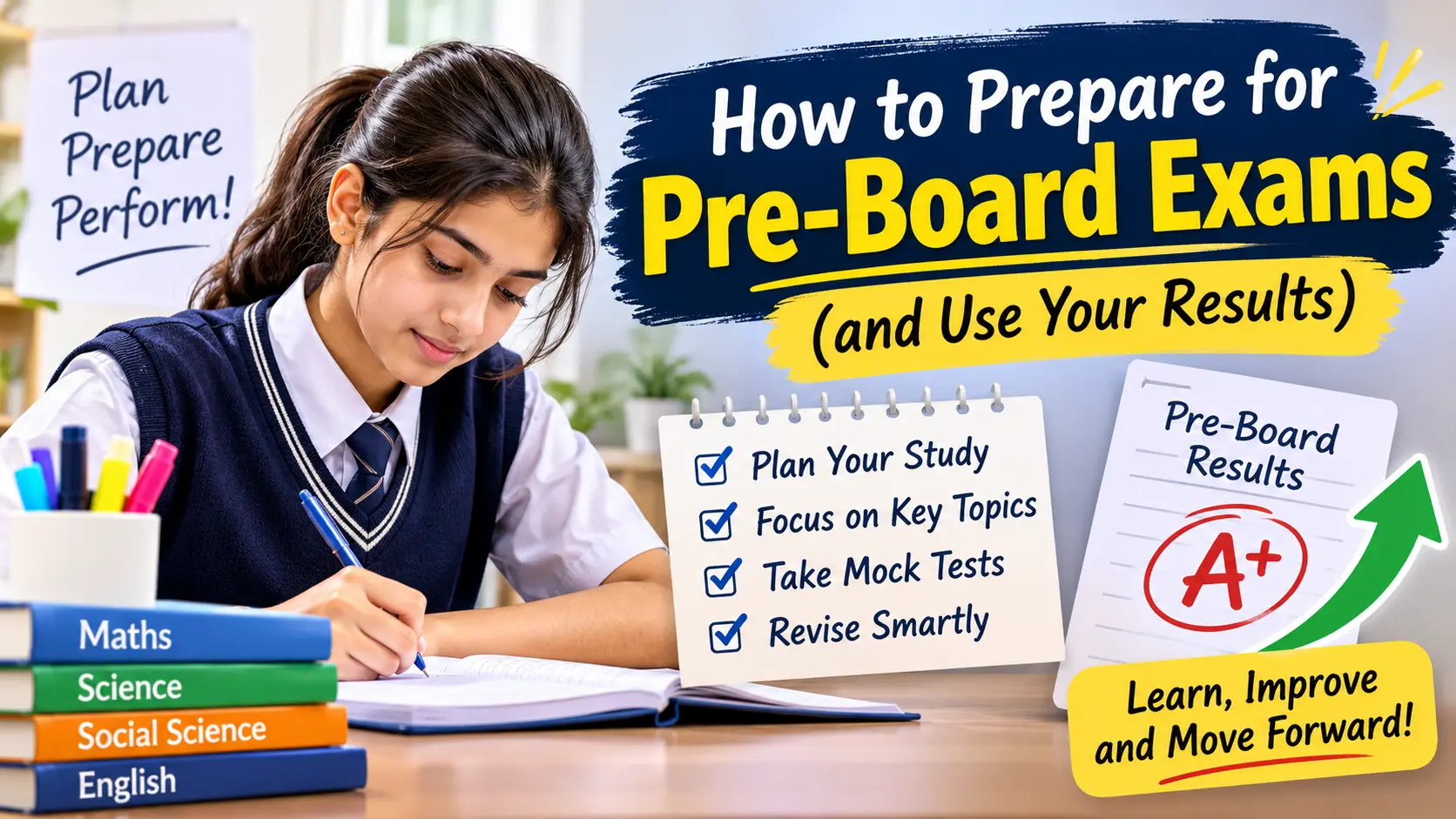
How to prepare for pre-board exams, in one line: finish your revision of the whole syllabus, practice full papers under a timer, and treat the results as a check-up, not a final verdict. Pre-boards are your school’s dress rehearsal for the board exams. What you learn from them in December and January matters more than the marks you get.
This guide gives you a four-week plan for pre-boards, a simple way to turn your results into a fix-it plan, and answers to the questions students ask most. It works for CBSE and ICSE, Class 10 and Class 12. For the full picture from now until February, see our board exam study plan.
When pre-boards happen, and why they matter
Most schools hold their first pre-board in December or early January, and some hold a second one in late January. They’re set and marked by your school, usually in the same format as the board paper.
The timing is tight in 2027. CBSE practical exams for regular schools start on 1 January, according to a Careers360 report on the CBSE circular, and theory exams begin on 16 February, as shown in the 2027 date sheet. ICSE Class 10 exams start on 15 February and ISC on 9 February. So your pre-boards will sit right next to practicals and project deadlines.
Pre-boards matter for three reasons:
- They show you which chapters you really know, and which you only think you know.
- They let you practise timing a full three-hour paper.
- They give your teachers a clear picture of where you need help before the real exam.
Pre-board marks don’t appear on your board marksheet. Some schools do use them when deciding which students need extra classes, so ask your school how it uses them.
How to prepare for pre-board exams: a four-week plan
Start about four weeks before your first pre-board paper. If you have less time, squeeze the weeks together but keep the order.
| Week | Main goal | What to do
|
|---|---|---|
| Week 1 | Close the gaps | List every chapter in each subject. Mark any you haven’t finished or don’t understand. Finish those first, using NCERT (or your ICSE textbook) and your class notes. |
| Week 2 | Revise everything once | Go through each chapter by testing yourself: close the book and answer the exercise questions, then check. Make one-page summaries for formulas, dates and definitions. |
| Week 3 | Full papers | Solve at least one full official sample paper per main subject in three hours, at the same time of day as your pre-board. Mark it against the official marking scheme. |
| Week 4 | Fix and rest | Rework every question you got wrong in Week 3. Revise your summaries and mistakes notebook. Keep sleep normal in the last three days. |
For the full papers, use CBSE’s official sample papers and marking schemes for 2026-27, for Class 10 and Class 12. ICSE and ISC students can use CISCE’s specimen papers. To fit all this around school, plan each day with a realistic study timetable for board exams.
Testing yourself beats rereading
When time is short, it’s tempting to reread notes. Research suggests that’s one of the least useful ways to revise. A large review of study techniques found that practice testing and spacing out revision help students remember far more, as the Association for Psychological Science’s summary of the review explains.
In practice, that means: close the book, write the answer, then check. Every question you get wrong now is one you’re less likely to get wrong in February.
Pre-board exam tips, subject by subject
Knowing how to prepare for pre-board exams also means knowing where each subject usually loses marks. These pre-board exam tips are written for Class 10, but most apply to Class 12 too.
- Mathematics: show every step, because marks are given for method. Practise case-based questions, and keep the last 15 minutes for checking calculations.
- Science: draw and label diagrams neatly, balance every chemical equation, and write units in numericals. Short, precise answers score better than long ones.
- Social Science: write in points with the key terms from the textbook, practise map work, and keep a one-page timeline for History.
- English: learn the formats for writing tasks such as letters, stay within word limits, and support literature answers with details from the text.
- Hindi or your second language: grammar sections are among the easiest marks to secure with regular practice, so don’t leave them for the end.
In any pre-board exam in Class 10, read the instructions on the paper carefully, especially about internal choices. Students regularly lose marks by answering both parts of an “either/or” question, or the wrong one.
The night before and the day of each paper
- The night before: revise your one-page summaries, not new chapters. Pack your pens, geometry box and water bottle. Sleep at your usual time.
- Reading time: use it to choose the order you’ll answer in and to spot the questions you’re sure of.
- During the paper: write the question number clearly, attempt every question, and keep 15 minutes at the end to check.
- Timing: divide your time by marks. In a three-hour, 80-mark paper, that’s a little over two minutes a mark, so don’t spend 15 minutes on a 2-mark question.
- After the paper: don’t spend hours discussing answers. Eat, rest, and then start on the next subject.
What to do after pre-boards: use your results
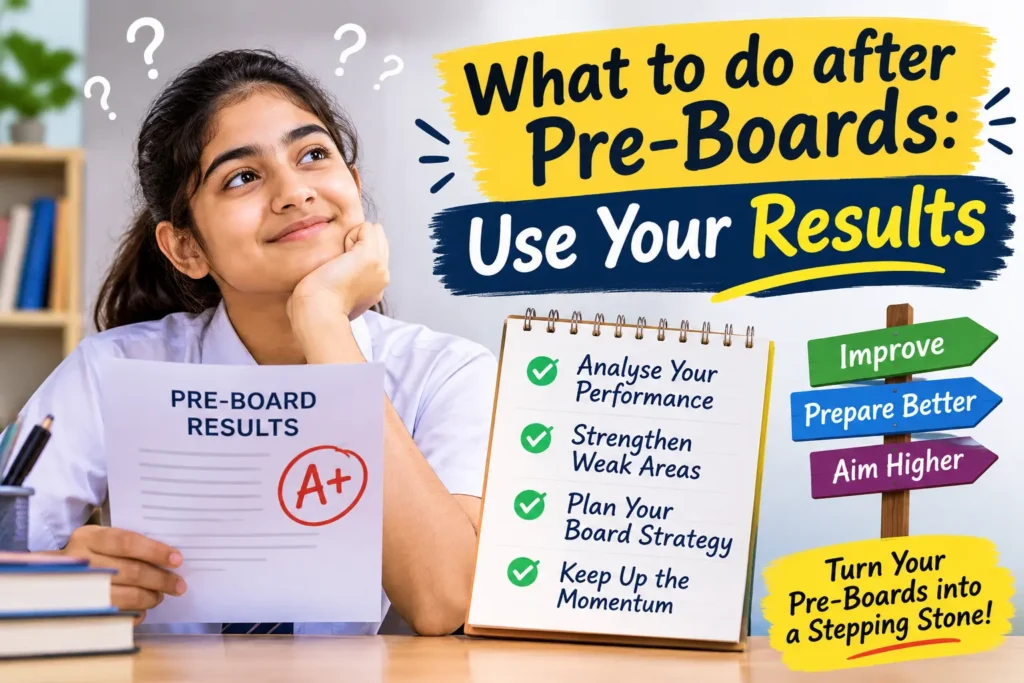
This is where pre-boards earn their value. When you get each paper back, sort every lost mark into one of these types.
| Type of mistake | What it looks like | How to fix it
|
|---|---|---|
| Didn’t know it | Blank answer, or a wrong concept | Relearn the topic, then solve 5 to 10 questions on it |
| Knew it, couldn’t recall it | “I knew this at home” | Test yourself on it every few days until it sticks |
| Careless slip | Calculation error, wrong unit, misread question | Underline key words in questions; keep checking time |
| Ran out of time | Last section rushed or left blank | Practice timed papers; follow the minutes-per-mark rule |
| Lost presentation marks | Missing steps, diagrams or keywords | Compare your answer with the official marking scheme |
Write the result in your mistakes notebook, then pick the three chapters that cost you the most marks in each subject. Those become your priority for January. Class 10 students can slot them into the week-by-week dates in our 100-day study plan.
Low marks in pre-boards? Read this first
Many students score lower in pre-boards than they expect. Schools often set them a little harder, and you may not have finished revising. A low score in December tells you where to work. It doesn’t predict your board result.
What to do: talk to your subject teacher about the paper, sort your mistakes using the table above, and make a short daily plan for the weakest subject. If you’re unsure how much time to give it, our guide on how many hours a Class 10 student should study has a month-by-month answer.
Pre-boards in Class 12
Working out how to prepare for pre-board exams in Class 12 is a little different if you’re also preparing for JEE, NEET or CUET. Pre-boards are a useful reminder that board papers need full written answers. Give the subjects that aren’t in your entrance exam, such as English, at least two or three blocks a week, and practice writing complete answers, not just choosing options.
Frequently asked questions
How to prepare for pre-board exams in one week?
Focus on the most important chapters in each subject, revise your summaries, and solve one full official sample paper per main subject under a timer. Rework your mistakes, skip new topics, and sleep normally the night before each paper.
Are pre-boards harder than board exams?
Often, yes. Many schools set pre-boards slightly harder than the board paper and mark them strictly, so students aren’t overconfident. Don’t panic over a lower score than you expected.
Do pre-board marks matter?
Pre-board marks don’t appear on your board marksheet. They help you and your teachers find weak areas. Some schools also use them to decide on extra classes, so ask your school how it uses them.
How many pre-board exams are there?
It depends on the school. Most hold one or two, usually between December and late January. Some groups of CBSE schools, called Sahodaya complexes, set a common pre-board paper.
Should I solve sample papers before pre-boards?
Yes. Solve at least one official sample paper per main subject in exam conditions before your pre-boards, and mark it against the official marking scheme. It’s the closest practice to the real paper.
How we put this guide together
To explain how to prepare for pre-board exams, we used CBSE’s official 2026-27 sample papers and marking schemes, the 2027 CBSE date sheet and practical exam schedule as reported by All India Radio News and Careers360, CISCE’s 2027 timetable, and research on study techniques summarized by the Association for Psychological Science. Your school’s pre-board dates will differ, so follow its schedule. Last updated: November 2026.