







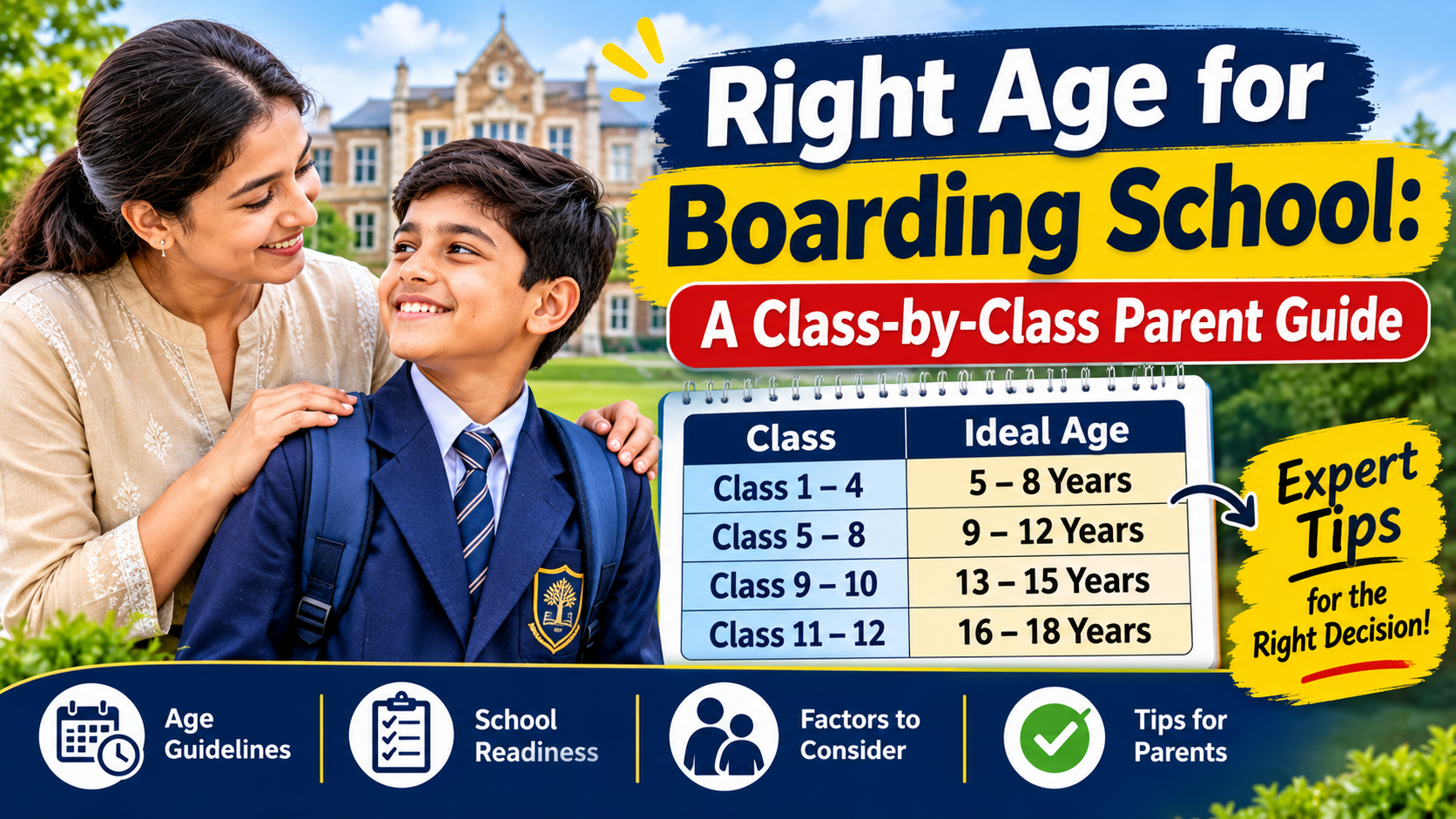
There’s no single right age for boarding school that suits every child. What matters more is whether your child is ready, and which class the school admits at. Most boarding schools in India take new students at only a few entry points, usually Class 1, 4, 6, 7 or 11, so the age question often becomes a question of which class to aim for.
This guide goes through each entry point class by class, explains what research says about age and homesickness, and gives you a readiness checklist to use with your own child. If you’re still weighing up boarding as a whole, read is boarding school right for your child first.
Is there a right age for boarding school? The short answer
For most families, the right age for boarding school falls somewhere between about 8 and 13, but readiness matters more than the number. A confident nine-year-old who has spent nights away from home may settle faster than an anxious thirteen-year-old who never has. Use age to narrow your options, and use the readiness checklist below to make the final call.
Schools also have their own entry classes. Among the 39 boarding schools in Dehradun on our list, 20 take children from Class 1, 10 start at Class 4, a few such as Welham Girls’ and SelaQui start at Class 6, and The Doon School admits only at Class 7 and 8. So the best age for boarding school in practice is often the next main entry point that fits your child.
What research says about age and homesickness
Almost every child misses home at first. A briefing paper from the American Camp Association, drawing on research by psychologist Christopher Thurber, found that about 20% of young people away from home report moderate-to-severe homesickness and about 7% report intense homesickness. It also lists the main risk factors: little previous experience away from home, earlier bad experiences away, low expectations of the new place, and feeling forced to go.
The American Psychological Association notes that higher levels of homesickness can be related to age, and that children with less experience away from home and less say in the decision tend to cope less well. In other words, age plays a part, but practice nights away and involving your child in the choice make a real difference at any age.
Class-by-class guide to boarding school entry
Here’s how the right age for boarding school looks at each of the usual entry points.
| Entry class | Typical age | What it’s like | Things to weigh |
|---|---|---|---|
| Class 1 to 3 | 6 to 8 | Junior boarding, with house parents and a very structured day | Very young to live away. Best for families with a strong reason, such as frequent transfers. |
| Class 4 to 5 | 9 to 10 | A common entry point, with a fresh group joining together | A good fit for independent children who have spent nights away before. |
| Class 6 to 7 | 10 to 12 | The start of middle school and the main entry point at many top schools | Often the easiest age to settle, but entry is competitive. |
| Class 8 to 9 | 12 to 14 | Seats usually open only when students leave | Friend groups are already formed, so settling can take longer. |
| Class 11 | 15 to 16 | A fresh intake after Class 10 boards | Only two years before Class 12 boards and entrance exams. |
Class 1 to 3: junior boarding
Some schools offer junior boarding from Class 1, with smaller dormitories, more adult supervision and plenty of routine. A boarding school for Class 1 can work for some families, especially those who move often for work. But six- to eight-year-olds still need a lot of day-to-day care, and many parents find it hard to be so far away at this age. Ask whether boarding itself starts in Class 1, because some schools take day students in the junior years and only start boarding later.
Class 4 to 5: an early but common start
Class 4 is a popular boarding school entry class. Welham Boys’ School in Dehradun and Mayo College in Ajmer, for example, both admit from Class 4. Children of nine or ten can usually manage basic self-care, and joining with a whole new group helps them make friends quickly. This is a good option for children who are independent and keen, but it’s still on the early side for many.
Class 6 to 7: the start of middle school
Many families see joining boarding school from Class 6 or 7 as the sweet spot. Children of 10 to 12 are usually more independent and better able to handle homesickness, and they still have several years to settle in before board exams. Several well-known schools admit mainly at this stage. Welham Girls’ School takes girls into Class 6 from a lower age limit of 10½ on 1 April of the year of joining, and The Doon School admits boys at Class 7 and 8.
Class 8 to 9: possible, but harder
At most schools, places in Class 8 and 9 open only when other students leave, so seats are few. Children joining now arrive in a group where friendships have already formed. Many still settle well, especially if they’re outgoing, but expect the first term to be harder.
Class 11: a fresh start after Class 10
Many boarding schools take a new group in Class 11. This suits students who want a particular stream, a stronger academic environment or more independence before college. The downside is time: there are only two years to settle in, and Class 12 boards and entrance exams come quickly. Joining in Class 10 or Class 12 is rare and usually not a good idea, because those are board exam years.
Is my child ready for boarding school? A checklist
Age gives you a range. This checklist helps you decide whether your child is ready now. The more of these that are true, the better the chances your child will settle well.
- They have spent at least a few nights away from home, with relatives, on a school trip or at a camp, and coped.
- They can manage daily self-care: bathing, dressing, keeping track of their things and getting to bed on time.
- They make friends reasonably easily and can ask an adult for help.
- They are curious or positive about boarding, and have been part of the decision.
- They can follow routines and rules without constant reminders.
- When they feel sad or upset, they usually recover within a day or so.
- Your family isn’t in the middle of a big change, such as a move or a bereavement.
Signs it may be worth waiting a year
- Your child has never slept away from home, or found it very hard when they did.
- They are strongly against the idea, even after visiting a school.
- The main reason for boarding is to fix behaviour or discipline.
- Your child has health or learning needs that the school can’t clearly support.
Waiting a year is not a failure. It often makes the eventual move much smoother. In the meantime, plan a few short stays away from home.
Age rules and timing to check
Once you’ve settled on the right age for boarding school and a target class, check each school’s age rules closely. Schools measure age on a fixed date, often 1 April of the year of joining or September of the year of the entrance test. The Doon School, for example, requires boys entering Class 7 to be over 11 and under 12 as of September in the year of the exam. A child who is a few months outside the range may not be allowed to sit the test.
Timing matters too. At selective schools, entrance tests are often held in the year before your child would join, so start planning one to two years ahead. Our guide to the boarding admission process explains each step and the 2027-28 timeline.
When you’re ready to shortlist, you can compare Dehradun’s boarding schools by entry class, board and fees. If you’d like a quieter hill-station setting nearby, it’s also worth looking at boarding schools in Mussoorie.
How to prepare your child, whatever their age
- Practise time away. A few nights with grandparents or a short camp builds confidence.
- Involve them in the choice. Visit schools together and let them share what they liked.
- Talk about homesickness. Tell them it’s normal to miss home and that it usually gets easier.
- Agree on contact. Know the school’s call and visit rules, and keep calls regular and predictable.
- Don’t promise an early pickup. Offering to bring them home if they don’t like it makes settling harder.
Frequently asked questions
What is the best age for boarding school in India?
Many families find that Class 4 to Class 7, roughly ages 9 to 12, works best, with Class 6 a popular choice. The right age for boarding school for your child depends on their readiness and on which classes your shortlisted schools admit to.
Is Class 1 too early for boarding school?
For most children, yes. Junior boarding exists and can work for families with a strong reason, but six-year-olds need a lot of everyday care. Many parents prefer to wait until at least Class 4.
Is Class 6 a good time to join boarding school?
Yes, for many children. They’re usually independent enough to manage, and they have several years to settle in before board exams. It’s also a main entry point at many schools.
Can my child join boarding school in Class 9 or Class 11?
Class 11 is a common entry point at many schools. Class 9 is possible when seats are free, but places are limited and settling in can take longer.
How do I know if my child is ready for boarding school?
Look at experience and attitude, not just age. Children who have spent nights away, manage their own routines, make friends easily and feel positive about boarding usually settle well.
How we put this guide together
We wrote this guide to help parents find the right age for boarding school for their own child, using real entry classes rather than general rules. It draws on our listing data for boarding schools in Dehradun (entry classes taken from school websites and published information), official admission pages of the schools named above, and published research on homesickness. Entry classes and age rules can change, so confirm them directly with each school. Last updated: November 2026.